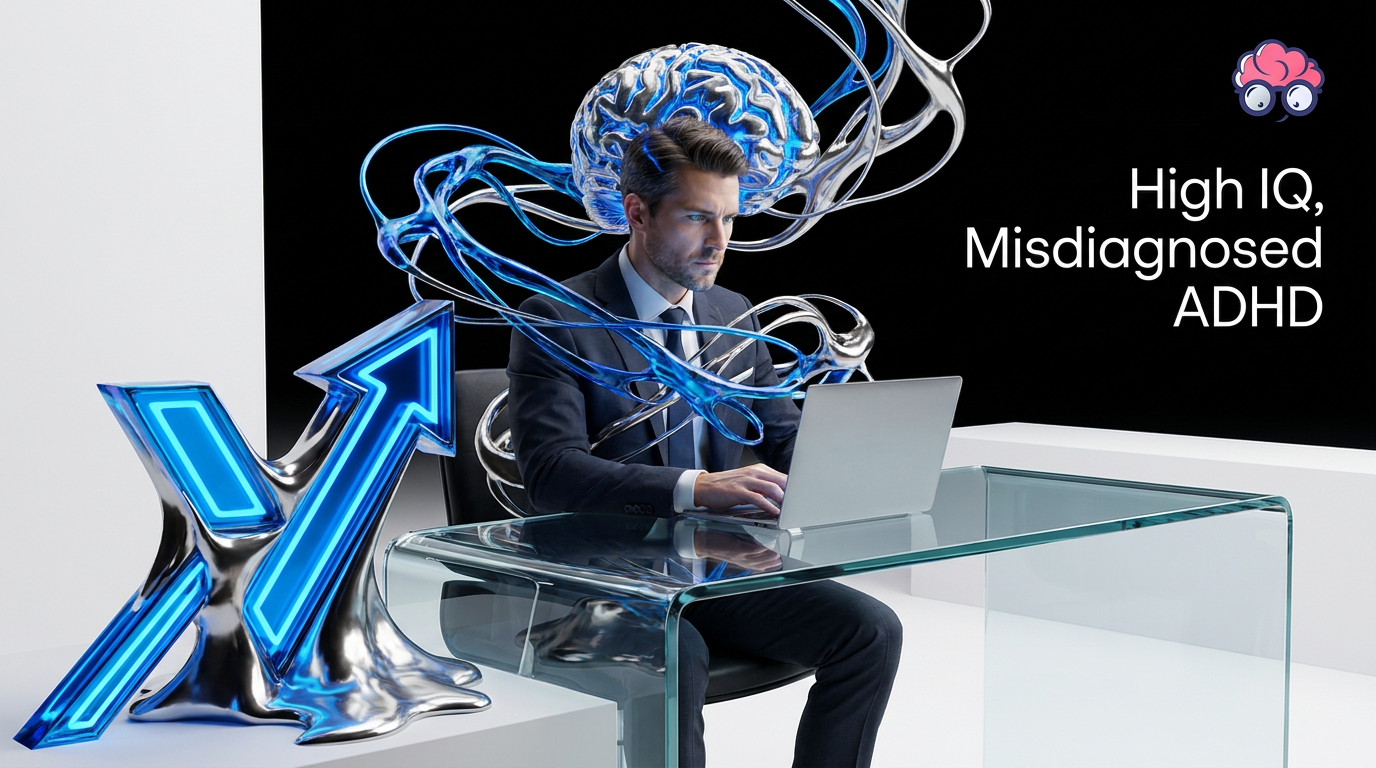
There is a cruel paradox at the centre of ADHD diagnosis: the smarter you are, the longer it takes to get help.
Research published in the Journal of Attention Disorders found that individuals with high IQ scores are significantly more likely to go undiagnosed with ADHD into adulthood. Not because they do not have it. But because their intelligence masks the symptoms well enough that nobody, including themselves, recognises what is actually happening.
This article is for the person who has always been told they were smart but lazy. Who was capable of brilliant work but inconsistent. Who could hyperfocus for 8 hours on something interesting and then completely fail to complete a routine 20 minute task. If any of that sounds familiar, keep reading.
Key Statistics
|
What Is Twice-Exceptional and Why Does It Matter?
The term twice-exceptional (often abbreviated 2e) refers to individuals who are both gifted in one or more areas and have a learning difference or neurodevelopmental condition. High IQ with ADHD is one of the most common twice-exceptional profiles.
The problem is that the educational and medical systems were not designed with these individuals in mind. Diagnosis processes for ADHD typically look for impairment. But a child with a 135 IQ and ADHD can coast through school on intelligence alone, appearing fine on the surface while privately struggling with disorganisation, emotional regulation, and an inability to start tasks that feel boring.
By the time they reach adulthood and the cognitive demands of life outpace their ability to compensate, they are often in their 30s or 40s before anyone connects the dots.
The Boredom Paradox: Why High IQ ADHD Looks Like Arrogance
One of the most misunderstood aspects of ADHD in high IQ individuals is what appears to be selective effort. They perform brilliantly in areas they find fascinating and completely fall apart in areas they find tedious.
From the outside this looks like arrogance, laziness, or simply not caring enough. From the inside it feels like trying to start a car engine that only works sometimes. The neurological reality is that ADHD brains have dysregulated dopamine systems. They are not motivated by importance or consequences in the same way neurotypical brains are. They are motivated by interest, novelty, challenge, urgency, or passion.
A person with high IQ and ADHD can write a 10,000 word essay on a topic they love the night before it is due and produce genuinely excellent work. They can then completely fail to submit a one-page form for three weeks because filling it in feels cognitively impossible.
This is not a character flaw. It is a neurological feature of how the ADHD brain allocates attention and activates motivation.
The Key Distinction: Childhood History
ADHD is a neurodevelopmental condition, meaning it is present from birth even if it goes unrecognised for decades. When assessing adults for ADHD, clinicians look for evidence that symptoms were present in childhood, even if they were not identified at the time.
ADHD traits that often look different in high IQ children:
- Daydreaming and being lost in thought (often praised as creativity or imagination)
- Not listening in class (often assumed to be boredom from being too advanced)
- Losing belongings constantly (often dismissed as absent-mindedness in a gifted child)
- Emotional outbursts (often attributed to sensitivity or intensity common in gifted children)
- Inconsistent performance (brilliant one week, apparently careless the next)
The key phrase that appears repeatedly in the histories of late-diagnosed high IQ adults is: ‘could do it when they tried’ or ‘not working to their potential’. Both of these suggest the child was being evaluated on outcomes rather than on how much effort it actually cost them to produce those outcomes.
Research Findings on High IQ and ADHD
A 2019 study published in Developmental Medicine and Child Neurology followed 1,655 children with ADHD over 10 years and found that those with higher IQ scores were substantially less likely to have their ADHD recognised and documented in school records, despite showing the same functional impairments as their average IQ peers.
Separate research from the University of Exeter found that high IQ acts as a cognitive buffer against some ADHD symptoms, particularly working memory deficits, because higher general intelligence allows for better compensatory strategies. But this compensation comes at a cost: chronic cognitive fatigue, anxiety from the effort of masking, and a persistent sense of underperformance relative to perceived potential.
Dr. Edward Hallowell, a psychiatrist who has ADHD himself and has spent over 30 years treating it, describes this profile as a Ferrari engine with bicycle brakes. The raw power is there. The control systems are inconsistent.
How sharp is your mind?
Take the Quiz Test and get your personalised report instantly.
Start the Test →⏱ 5 min · 📊 Instant score
Signs It Is High IQ Boredom, Not ADHD
It is worth being accurate here. Not everyone who finds routine tasks difficult has ADHD. High IQ individuals can experience genuine boredom-based underperformance that is distinct from ADHD. The key differences:
- Gifted boredom: Can complete boring tasks when there is a meaningful reason, just finds them unstimulating
- ADHD: Genuinely cannot initiate or sustain effort on boring tasks regardless of motivation or consequences
- Gifted boredom: Consistent performance across preferred activities
- ADHD: Inconsistent performance even in preferred areas, especially when external demands increase
- Gifted boredom: Organised and systematic when interested
- ADHD: Disorganised across the board, time blindness, object permanence issues
The most reliable distinguishing factor is pervasiveness. ADHD symptoms show up across all areas of life. Gifted boredom shows up specifically in contexts that lack challenge or novelty.
Signs It Might Actually Be ADHD
- You have always lost things, forgotten appointments, and missed deadlines despite genuinely intending to do better
- Time feels different to you. You are either fully absorbed in something or time does not exist at all
- You have a graveyard of unfinished projects that you were extremely enthusiastic about starting
- You interrupt people without meaning to and feel genuinely bad about it afterward
- You can sit still but your mind never stops. You are constantly thinking about 4 things simultaneously
- You need urgency or genuine interest to activate. Deadlines are the only thing that consistently works
- You have been called inconsistent, unreliable, or difficult your entire life despite being capable and well-intentioned
Treatment Differences
Treatment for high IQ adults with ADHD often looks different from standard ADHD treatment protocols.
If you are high IQ with ADHD:
- Medication alone is rarely sufficient. The compensatory strategies you developed over years can mask progress and need to be actively unlearned alongside medication
- Coaching focused on systems rather than willpower produces better outcomes than traditional CBT in many cases
- Environmental design matters enormously. Structuring your environment to remove friction from important tasks and add friction to distracting ones leverages your intelligence rather than fighting your neurology
- Understanding your interest-based nervous system is itself therapeutic. Many people experience significant relief simply from having a framework that explains their lifelong experience
Frequently Asked Questions
Can you have a high IQ and still have ADHD?
Yes, absolutely. IQ and ADHD are independent variables. Having a high IQ does not protect against ADHD and does not reduce the genuine neurological differences involved. What it does is mask the functional impairment well enough that diagnosis is frequently missed or delayed.
What IQ is considered high for ADHD masking to occur?
Research suggests masking becomes significant above IQ 115, which is one standard deviation above average. At IQ 125 and above, the likelihood of delayed diagnosis increases substantially. However, masking can occur at any intelligence level and is also influenced by socioeconomic status, gender, and cultural context.
Is ADHD more common in gifted people?
Studies suggest ADHD may appear in gifted populations at rates similar to or slightly higher than the general population. However, the presentation is often different and harder to identify, leading to systematic underdiagnosis in this group.
How do I get assessed for ADHD as an adult?
See your GP as a first step and describe the specific functional impairments you experience, not just the behaviours. You can also seek a private assessment from a chartered psychologist or psychiatrist specialising in adult ADHD. Self-assessment tools like the Mindaura ADHD screening test can give you useful data to bring to that conversation.
Can ADHD medication help someone with a high IQ?
Yes. Medication for ADHD works by normalising dopamine and norepinephrine regulation in the prefrontal cortex. For high IQ individuals this often produces a striking effect described as finally being able to use my brain properly rather than fighting it all the time.
Does ADHD affect IQ test scores?
Yes. ADHD affects processing speed and working memory, both of which are measured components of IQ tests. This means the IQ scores of people with untreated ADHD may underestimate their actual cognitive potential. Studies show that treating ADHD can improve IQ test performance by 5-10 points on average.
What are the best careers for high IQ adults with ADHD?
Careers that combine high cognitive demand with variety, autonomy, and genuine interest tend to work best. Common high performers include entrepreneurs, surgeons, emergency medicine physicians, journalists, researchers, creative directors, and trial lawyers. The common thread is high stakes, variety, and cognitive challenge.
Can you have ADHD and not have it affect your daily life?
At high enough IQ levels, some individuals develop extensive compensatory systems that make ADHD nearly invisible in daily functioning. However, the cost of maintaining these systems is typically chronic fatigue, anxiety, and a persistent feeling of exhaustion from tasks that seem to come easily to others.
Is Mindaura’s ADHD test clinically valid?
The Mindaura ADHD screening test is based on validated self-report instruments including the Adult ADHD Self-Report Scale (ASRS) methodology. It is a screening tool, not a clinical diagnosis. If your results indicate significant ADHD traits, the recommendation is always to seek professional assessment.
What is rejection sensitive dysphoria and does it relate to high IQ ADHD?
Rejection Sensitive Dysphoria (RSD) is an intense emotional response to perceived criticism or failure that is strongly associated with ADHD. High IQ individuals with ADHD often experience RSD acutely because the gap between their perceived capability and their actual inconsistent performance creates frequent experiences of not meeting their own or others’ expectations.
Conclusion
If you have spent your life being told you are smart but not living up to your potential, there is a reasonable chance that ADHD has been the missing piece of the puzzle. The condition does not care how intelligent you are. In many ways, high intelligence makes it harder to identify and harder to accept.
Getting screened is not about labelling yourself. It is about understanding how your brain actually works so you can stop trying to run it on a system designed for a different kind of brain.
How sharp is your mind?
Take the Quiz Test and get your personalised report instantly.
Start the Test →⏱ 5 min · 📊 Instant score