
Choosing a career is one of life’s biggest decisions. Yet most people make it on whim, parental pressure, or “what sounds interesting.”
Career assessment tests—combined with IQ and personality testing—remove guesswork and point you toward careers where you’ll actually thrive.
This guide shows how career assessment works and how to use results to make intentional career decisions.
What Is Career Assessment?
Career assessment is different from personality and IQ testing.
IQ Test measures: How your brain processes information Personality Test measures: How you interact and prefer to work Career Assessment measures: What work actually interests and excites you, combined with aptitude for specific roles
Career assessment asks: What activities energize you? What problems interest you? What impact do you want? What environment supports your happiness?
Then it matches your answers to actual careers with detailed job descriptions, salary ranges, growth opportunities, and education requirements.
How Career Assessment Works
Quality career assessments follow this process:
Step 1: Interest Inventory
You rate your interest in various activities: – “How interested are you in building things?” (1-10) – “How interested are you in helping people?” (1-10) – “How interested are you in creative expression?” (1-10)
The test asks 50-100 such questions covering different domains.
Step 2: Values Clarification
You indicate what matters in work: – Money and financial security – Helping others and making impact – Creative expression – Learning and growth – Autonomy and freedom – Structured routine – Travel and variety
Step 3: Skills & Aptitudes
Assessment identifies: – Natural abilities (from your history and testing) – Learned skills (education, experience) – Potential aptitudes (what you could develop)
Step 4: Matching
The assessment matches: – Your interests + values + aptitudes – To actual careers – With specific job titles, descriptions, salary, education needed
Result: 5-20 career suggestions ranked by fit.
Types of Career Assessments
Strong Interest Inventory (Professional)
- Duration: 15 minutes
- Cost: $10-20
- Accuracy: 85%+
- What it measures: 6 career interest themes
- Best for: General career exploration, mid-career decisions
Myers-Briggs Career Guidance
- Based on: MBTI personality type
- Cost: Usually included with MBTI assessment
- Accuracy: 75% (since MBTI less scientifically validated)
- Best for: Understanding work style, communication preferences
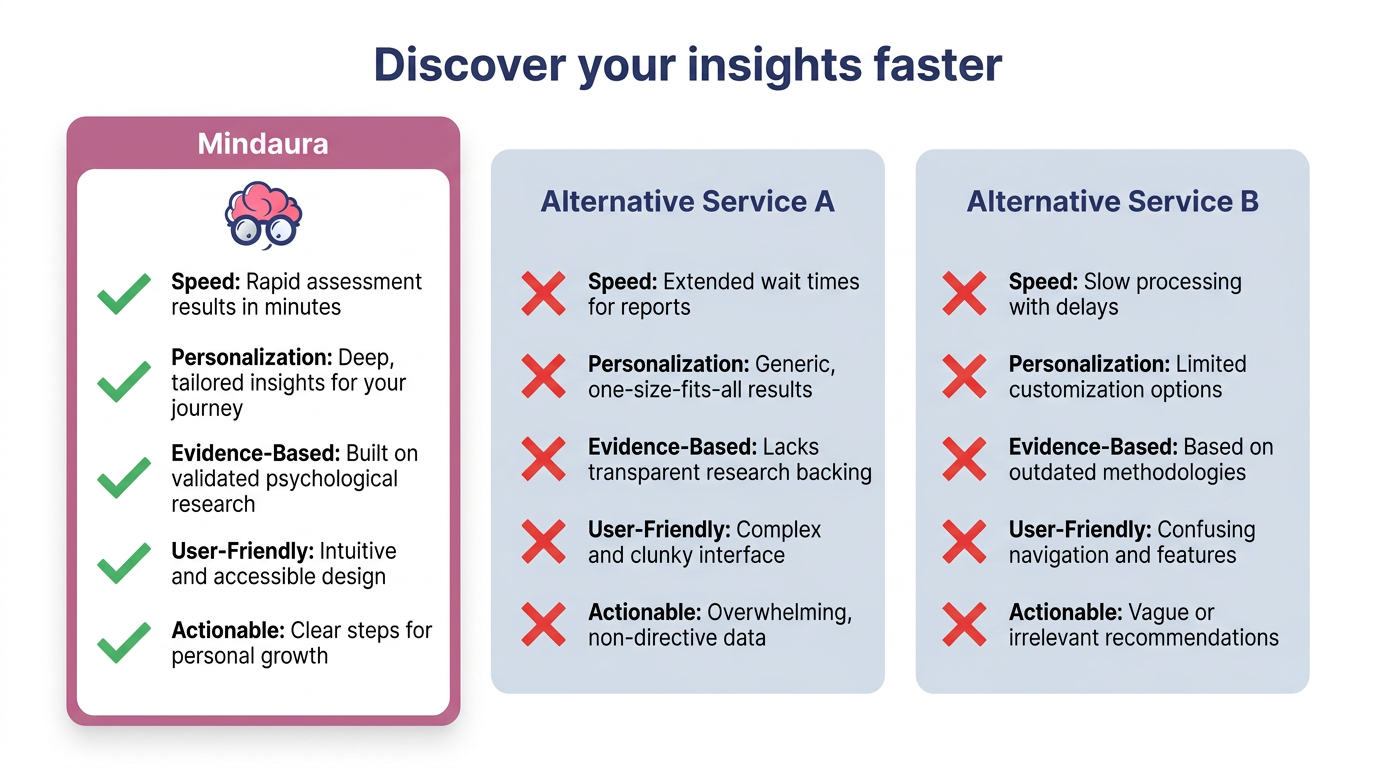
Mindaura Career Assessment
- Duration: 15 minutes
- Cost: Free-$15
- Accuracy: 85%
- Best for: Quick assessment integrated with IQ and personality
- Unique: Combines with your IQ and personality results for holistic picture
**O*NET Interest Profiler (Free)**
- Duration: 10 minutes
- Cost: Free
- Accuracy: 70-75%
- What it measures: 6 career clusters
- Best for: Budget-conscious exploration
Kuder Career Assessment
- Duration: 20 minutes
- Cost: $0-15 depending on version
- Accuracy: 80%
- What it measures: Skills and interests
- Best for: High school and college students
What Career Assessment Predicts
Career assessment PREDICTS:
✅ Work environment fit (where you’ll be happy) ✅ Activities you’ll find engaging ✅ Problems you’ll want to solve ✅ Impact you’ll find meaningful
Career assessment DOES NOT predict:
❌ Success in specific careers (success is 70% effort, 20% opportunity, 10% fit) ❌ Salary (depends on market, negotiation, experience) ❌ Job availability in your area ❌ Whether you’ll be good at the job (that requires skills + effort)
Use assessment for direction, not destiny.
How to Use Career Assessment Results
Step 1: Review Top Matches
Assessment suggests 5-20 careers. Review top 5-7.
Don’t limit yourself to top recommendation. Look at all suggestions. Sometimes #10 is better fit than #1 based on your additional knowledge.
Step 2: Research Careers in Depth
For each career, research: – Typical day-to-day (talk to people in role) – Education/training required – Salary ranges (glassdoor.com, payscale.com) – Job growth (Bureau of Labor Statistics) – Stress level and work-life balance
Step 3: Consider Other Factors
Career assessment doesn’t factor in: – Geographic availability – Salary requirements for your life – Work-life balance preferences – Travel vs stability – Entrepreneurship vs employment
Factor these in independently.
Step 4: Test the Theory
Best careers come from testing: – Volunteer or intern in the field – Shadow someone in the role – Take relevant classes to see if you like the material – Join professional communities online
Assessment is hypothesis. Real experience validates or refutes.
Step 5: Develop Required Skills
Even if career matches perfectly, you need skills: – Education (degree, certifications) – Experience (internships, entry-level roles) – Soft skills (communication, collaboration, problem-solving)
Assessment points direction. You provide effort.
Career Aptitude vs Interest
Important distinction:
Career Interest = What you find interesting Example: High interest in science, but low interest in research methodology
Career Aptitude = What you’re good at Example: Excellent at research methodology, but find it tedious
Ideal Match = High interest AND high aptitude
If high interest but low aptitude: You’ll find it interesting but struggle If high aptitude but low interest: You’ll do well but feel bored
Best careers match both.
Personality + IQ + Career Assessment Together
Single assessment is incomplete:
IQ tells you cognitive capability level Personality tells you work style preferences Career Assessment tells you what work interests you
Example:
Person A: – IQ: 130 (top 2%, can do anything) – Personality: INTJ (independent, strategic) – Career Assessment: High interest in helping people, teaching, counseling
Ideal career: Not research (boring despite capable). Teaching advanced mathematics (uses high IQ, helps people, works with ideas).
Person B: – IQ: 105 (above average) – Personality: ENFP (social, creative, enthusiastic) – Career Assessment: High interest in variety, learning, people impact
Ideal career: Not management (requires consistency they don’t enjoy). Sales of innovative products, training and development, or nonprofit program leadership.
Same IQ level. Completely different career recommendations based on personality + interests.
[Combine all three assessments | /personality-iq-career-testing] for most complete picture.
Common Career Assessment Mistakes
Mistake 1: Over-Trusting Top Recommendation
Assessment suggests #1 career. You pursue it, hate it, feel like failure.
Reality: Top recommendation is best match based on assessment. Doesn’t mean it’s perfect, and doesn’t mean other careers aren’t equally good.
Mistake 2: Not Researching Actual Jobs
Assessment says “accounting is good fit.” You imagine exciting number work. Reality of daily accounting: repetitive data entry, stress about deadlines, limited creativity.
Research actual jobs before committing.
Mistake 3: Assuming You’ll Be Good Without Effort
Assessment says “engineering” is perfect match. You start engineering degree, struggle with physics, drop out.
Interest doesn’t equal innate ability. You still need to develop skills and effort.
Mistake 4: Dismissing Results You Dislike
Assessment suggests “you’d be happy in accounting.” You ignore it because “accountants are boring.”
Stereotypes are false. Every field has passionate, interesting people. Don’t dismiss based on stereotype.
Mistake 5: Changing Careers Every Time Something Feels Hard
Career feels frustrating. You retake assessment. New suggested career. Pursue it. Hits same frustration point. Repeat endlessly.
Most careers have frustration stages. Quitting every time is called “career floundering.”
Give career 2-3 years before deciding it’s wrong fit.
When to Retake Career Assessment
Retake if: – You’re making major career decision – You’ve had major life changes (significant burnout, values shift) – You’re bored in current career (reassess what’s actually missing) – You’re early career and trying to figure out direction
Don’t retake if: – You just completed assessment (give it time) – You’re having temporary frustration (normal in any job) – You’re unhappy but haven’t addressed root issue (might be company, boss, role fit—not career itself)
Conclusion
Career assessment removes guesswork from career decisions. Combined with understanding your IQ and personality, it creates complete picture of: – How you think – How you work best – What work interests you – What careers match all three
[Take the Mindaura Career Assessment | /career-assessment] alongside IQ and personality tests for comprehensive picture.
Your career is where you spend 30-40% of your life. Choose intentionally.
FAQ (10 Questions)
- Are career assessment tests accurate?
Good career assessments (85%+ accuracy) identify careers you’ll likely find interesting. However, they don’t predict success or guarantee satisfaction. Use them as guidance, not destiny. Combine with research and real-world testing.
- Can I take multiple career assessments?
Yes. Different assessments use different frameworks and might suggest different careers. Taking 2-3 different assessments and looking for patterns gives better picture than single assessment. Consistent suggestions across tests are more reliable.
- What if my career assessment suggests jobs I’ve never considered?
That’s valuable data. Assessment sees patterns in your interests/aptitudes you might miss. Research suggestions you wouldn’t have considered otherwise—they might be good fits you never thought about. Don’t limit to expected suggestions.
- Should I base my career choice solely on assessment results?
No. Use assessment as one input. Also consider: Job market (is field growing?), salary (does it meet your needs?), geography (where are jobs?), values alignment (matches your principles?), growth opportunity (can you advance?). Assessment is starting point, not final answer.
- Can career assessment help if I’m unhappy in current job?
Yes, but also examine whether unhappiness is about job fit or specific situation (boss, company, role within field). Sometimes wrong job in right field. Sometimes right job in wrong company. Assessment helps clarify if you need career change or situation change.
- What if I love my current job but assessment suggests something else?
Assessment results are based on interests/aptitudes. If you’re genuinely happy, don’t change based on assessment. Satisfaction trumps theory. Assessment is guidance, not requirement. Stay if you’re thriving.
- Can I use career assessment results for job interviews?
Not directly. Don’t mention “my career assessment suggested this job.” But use insights to understand your strengths and how you’ll contribute. “My strengths are X and Y, which is why I’m excited about this role’s requirements.”
- Is career assessment good for career changers?
Excellent for career changers. Shows you what kind of work might better match your values, interests, and strengths than current field. Helps identify which change makes sense versus impulsive escape from current frustration.
- Can assessment help me decide between two careers I’m considering?
Yes. Assessment shows which matches your interests/aptitudes better. But also research both deeply, shadow people in each role, and let real experience inform decision. Assessment is tiebreaker, not decider.
- What if assessment suggests career that requires skills I don’t have?
That’s what education and experience are for. Assessment shows direction. You develop required skills through school, training, internships, entry-level roles. Don’t let skill gap discourage you—most people develop skills after entering field.
INTERNAL LINKS
- [IQ Testing Guide] – /ultimate-guide-online-iq-testing
- [Personality Testing Guide] – /complete-guide-personality-tests
- [Best Careers for Your Personality] – /best-careers-personality-type
- [Personality + IQ + Career Together] – /personality-iq-career-testing
EXTERNAL LINKS
- Strong Interest Inventory – https://www.pearsonassessments.com
- O*NET Interest Profiler – https://www.mynextmove.org
- Bureau of Labor Statistics Career Data – https://www.bls.gov