Intelligence quotient testing has transformed dramatically. What once required a psychologist’s office can now be completed on your phone in 20 minutes. But which online IQ tests actually deliver accurate results?
This comprehensive guide breaks down everything about online IQ testing—from how different platforms work to which ones deliver real insights. Whether you’re exploring your cognitive abilities for personal growth or need results for career planning, you’ll find answers here.
What is an IQ Test?
IQ stands for Intelligence Quotient. It’s a standardized measure of cognitive ability, designed to assess how quickly and effectively your brain processes information.
How IQ is Calculated
IQ scores use a formula comparing your performance to a reference group (usually your age):
- Average IQ score: 100
- Standard deviation: 15 points
- Scores follow bell curve distribution
What IQ Tests Measure
- Logical reasoning (problem-solving, pattern recognition)
- Verbal comprehension (understanding words, language)
- Spatial awareness (visualizing objects in space)
- Processing speed (working quickly through problems)
- Working memory (holding and manipulating information)
What IQ Tests DON’T Measure
- Creativity or artistic ability
- Emotional intelligence
- Practical wisdom or common sense
- Motivation or work ethic
- Success in life (IQ explains only 25% of success variance)
- Personality traits
- Social skills or leadership potential
Many high-IQ individuals struggle with life outcomes because IQ alone doesn’t predict success. You need emotional intelligence, persistence, and clear goals.
Types of Online IQ Tests
Professional IQ Tests (Medical Grade)
WAIS-IV (Wechsler Adult Intelligence Scale)
- Administered by: Licensed psychologists
- Duration: 60-90 minutes
- Cost: $300-500
- Accuracy: 98%+
- When to use: Legal documentation, disability claims
Stanford-Binet
- Administered by: Psychologists
- Duration: 45-75 minutes
- Cost: $200-400
- Accuracy: 95%+
- When to use: Giftedness identification, clinical assessment
Raven’s Progressive Matrices
- Format: Pattern recognition puzzles (language-free)
- Duration: 45 minutes
- Cost: $100-200
- Accuracy: 94%
- When to use: Non-verbal ability assessment
Commercial Online Tests
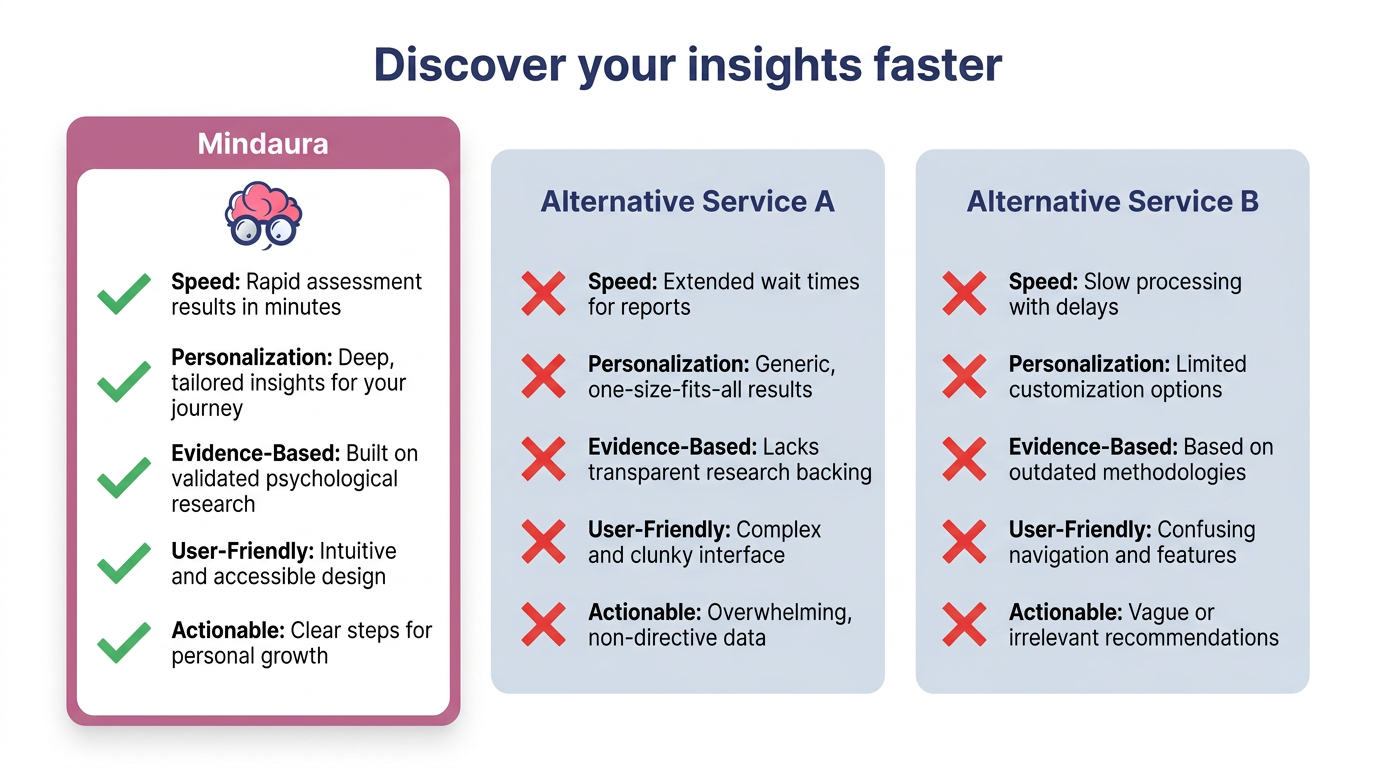
Mindaura IQ Assessment
- Duration: 20 minutes
- Cost: Free (basic) to $15 (detailed report)
- Accuracy: 85%
- When to use: Career planning, personal development
- Format: Mobile-optimized, instant results
- Unique feature: Links directly to career assessment
Free Online Tests
- Typical accuracy: 50-70%
- Sample sizes: Often <1000 people
- Validation: Minimal or none
- Best use: Conversation starter, not meaningful assessment
How Accurate Are Online IQ Tests?
Research shows correlation between quality online tests and professional assessments ranges from 0.75-0.92 (quite strong). However, several factors affect accuracy:
Factors That Increase Accuracy
- Quiet testing environment
- Full alertness (tested in morning, not tired)
- No interruptions
- Following instructions precisely
- Sufficient time (no rushing)
Factors That Decrease Accuracy
- Distractions (noise, notifications)
- Testing while tired or unwell
- Performance anxiety
- Rushing through questions
- Technical issues (slow internet)
- Poor test design
The Practice Effect
If you retake the same test within 2-3 months, you’ll score 5-10 points higher due to familiarity. Psychologists recommend 6+ months between retests.
IQ Score Ranges & Interpretation
| Score Range | % of Population | Classification | What It Means |
|---|---|---|---|
| Below 70 | 1% | Significantly below average | Cognitive challenges, may qualify for support |
| 70-84 | 7% | Below average | Some struggle with abstract reasoning |
| 85-100 | 27% | Average (lower) | Normal cognitive ability |
| 100-115 | 27% | Average (upper) | Above average capability |
| 115-130 | 9% | Very superior | Top 10% cognitively |
| 130+ | 1-2% | Genius level | Exceptional cognitive ability |
Important Context
- IQ is relative to your age group
- Cultural factors may influence scores
- Score is snapshot in time (sleep, mood affect it)
- IQ explains 25-30% of career success
How to Take an IQ Test for Best Results
Before the Test
- Get 7-8 hours sleep
- Eat balanced breakfast
- Avoid caffeine for 6+ hours before
- Choose testing time when most alert (usually morning)
- Plan 2+ hours uninterrupted time
During the Test
- Find absolutely quiet environment
- Have water available
- Answer thoughtfully, don’t rush
- Make best guess if unsure
- Stay calm (anxiety lowers scores 5-10 points)
After the Test
- Don’t obsess over score
- Wait 2-3 weeks before discussing
- If retesting, wait minimum 6 months
Should You Take a Professional IQ Test?
Get Professional Testing If:
- You need legal/medical documentation
- You suspect giftedness in your child
- You’re exploring disability accommodations
- You have major life decision (career change, education)
- You have history of learning struggles
Skip Professional Testing If:
- You’re just curious about general intelligence
- You’re planning career transition (commercial test sufficient)
- You want quick self-assessment
- You’re on budget
IQ Score FAQs
1. Can your IQ change?
Relatively stable in adulthood. Scores may fluctuate 5-10 points based on test conditions. Major changes (20+ points) usually indicate different test type or testing error. Cognitive training can improve scores 2-3 points.
2. What’s a “good” IQ score?
No objectively “good” score. For most careers: 100-115 is adequate. For STEM fields: 115+ advantageous. For life satisfaction: IQ barely matters. Motivation matters more than IQ.
3. Is retaking an IQ test cheating?
Not at all. Practice effect is real (5-10 point increase). Psychologists expect retesting after 6+ months. Multiple tests give more reliable picture than single test.
4. Why do free tests seem to give high scores?
Confirmation bias. Free tests often ask easier questions, score generously, and benefit from you remembering flattering results.
5. Can you study for an IQ test?
Partially. Practicing pattern recognition helps slightly (2-3 points). Reducing test anxiety helps (5+ points possible). You can’t fundamentally change cognitive ability with short-term prep.
6. What’s the difference between IQ and aptitude tests?
IQ test: General cognitive ability across domains. Aptitude test: Specific ability in one area. Use IQ for general understanding, aptitude tests for career fit.
7. How often should you retake an IQ test?
Once every 6-12 months maximum. More frequent testing means practice effect invalidates results. One retest across 2 years gives most accurate baseline.
8. Are online tests as valid as professional tests?
Not for legal purposes. Professional tests: 98% accuracy, accepted by courts. Commercial online tests: 85% accuracy, sufficient for personal insight. For self-discovery: commercial test is adequate. For documentation: professional test required.
9. Do IQ tests measure “real intelligence”?
IQ tests measure cognitive ability (one component of intelligence). They measure problem-solving, reasoning, pattern recognition. They don’t measure creativity, emotional intelligence, practical wisdom. So IQ is partial, not complete measurement.
10. What should I do with my IQ score?
Use for: Career planning, learning style identification, personal development, education decisions. Don’t use for: Self-judgment, success prediction, limiting beliefs. Remember: IQ is one factor among many.