
MindAura runs four science-backed tests on one adaptive psychometric assessment engine: an AI-powered IQ test, a Big Five personality test, an adult ADHD self-assessment, and a Holland Code RIASEC career test.
Every result comes back right away with a real percentile ranking. No vague label. No paywall.




Big Five / OCEAN
WAIS-Style Cognitive Domains
Holland Code (RIASEC)
DSM-5 Aligned ADHD Screening
GDPR & CCPA Compliant
MindAura is one platform with four science-backed tests: an AI-powered IQ test, a Big Five personality test, an adult ADHD self-assessment, and a Holland Code RIASEC career test, all on one adaptive scoring engine. Most other sites only offer one of these. That means your results never connect to each other.
MindAura works differently. Your thinking style, your personality, and your career fit are not separate things. Take more than one test and the platform links your results together on its own. Every test is free or low-cost, takes under 20 minutes, and gives you a plain-language, percentile-ranked report. No vague label. No paywall.
Tests your reasoning, memory, and processing speed. These are the same domains professional WAIS-style batteries score.
Scores you on the five OCEAN traits. More precise than an MBTI-style box, plus tips for your relationships.

Screens attention, impulse control, and executive function. Built around the same categories ASRS
Matches your interests and aptitude to real job profiles. Based on the same RIASEC model behind the U.S. Department of Labor's O*NET database.
Tests your reasoning, memory, and processing speed. These are...
Scores you on the five OCEAN traits. More precise than an MBTI...
Screens attention, impulse control, and executive function. Built arou..
Matches your interests and aptitude to real job profiles. Based on the...
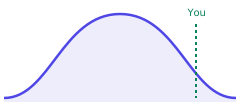
Where your score sits on the normal bell curve, relative to the reference sample.
Your Big Five profile plotted across all five dimensions at once.

A live look at how question difficulty adjusts to your answers in real time.

Start with IQ, personality, ADHD, or career. There's no required order, though IQ first, then personality, then career builds on itself naturally.
Most questions take just a few seconds. The adaptive engine adjusts the difficulty as you go. Trust your first instinct. It beats overthinking.
We check your answers for consistency, compare them to a large reference sample, and calculate your percentile ranking in seconds.
See your full results on-screen right away. No email gate. Download a PDF if you want to keep or share it.
Fluid reasoning, working memory, and processing speed. These are the same domains used in established tests like the WAIS.
The most tested framework in personality psychology. It has more than fifty years of research behind it.
Organized around three types: inattentive, hyperactive-impulsive, and combined. This matches how adult ADHD research groups them.
The same interest model behind the U.S. Department of Labor's O*NET database. We add an aptitude layer on top.
We publish this range honestly instead of rounding it up. Here is exactly where online testing stands next to a clinical evaluation.
Use the IQ and career tests together for an evidence-based starting point on a major or a first job.
Use the career and personality assessments to sanity-check a pivot before making it official.
Use the ADHD self-assessment as your first step toward a real evaluation. It gives you the words for that conversation.
Use the personality test to understand recurring friction and communicate across different working styles.
Based on that, start with the IQ Test.
Based on that, start with the Personality Test.
Based on that, start with the ADHD Self-Assessment.
Based on that, start with the Career Test.
Based on that, start with the IQ Test.
Based on that, start with the Personality Test.
Based on that, start with the ADHD Self-Assessment.
Based on that, start with the Career Test.
| Factor | Mindaura | Free Ad-Supported Quizzes | In-Person Clinical Testing |
|---|---|---|---|
| Cost | Free / low-cost | Free | $300–$3,000+ |
| Time to results | Instant | Instant | 1–3 weeks |
| Accuracy | ~85% correlation | Unvalidated, varies widely | 95–98% |
| Framework used | Named, peer-reviewed | Usually undisclosed | Named, peer-reviewed |
| Legal / clinical validity | No | No | Yes |
| Best for | Self-understanding, career & life decisions | Five minutes of curiosity | Documentation & diagnosis |
Each game measures one thing and scores it against everyone else who has played. No sign-up, instant result.
Working memory span
How many digits can you hold in working memory?
126 plays Memory Play the game ~2 minProcessing speed
Click the instant the screen turns green.
Speed Play the game ~3 minVisuospatial memory
A pattern of squares flashes. Recreate it from memory.
71 plays Memory Play the game ~3 minSpatial working memory
Memorise the numbers, then click them in order.
Memory Play the gameQuestions