You got your IQ test score. Now what? You have a number. But numbers mean nothing without context.
The difference between understanding and misinterpreting your IQ is the difference between meaningful self-knowledge and useless ego inflation.
The Bell Curve Explained
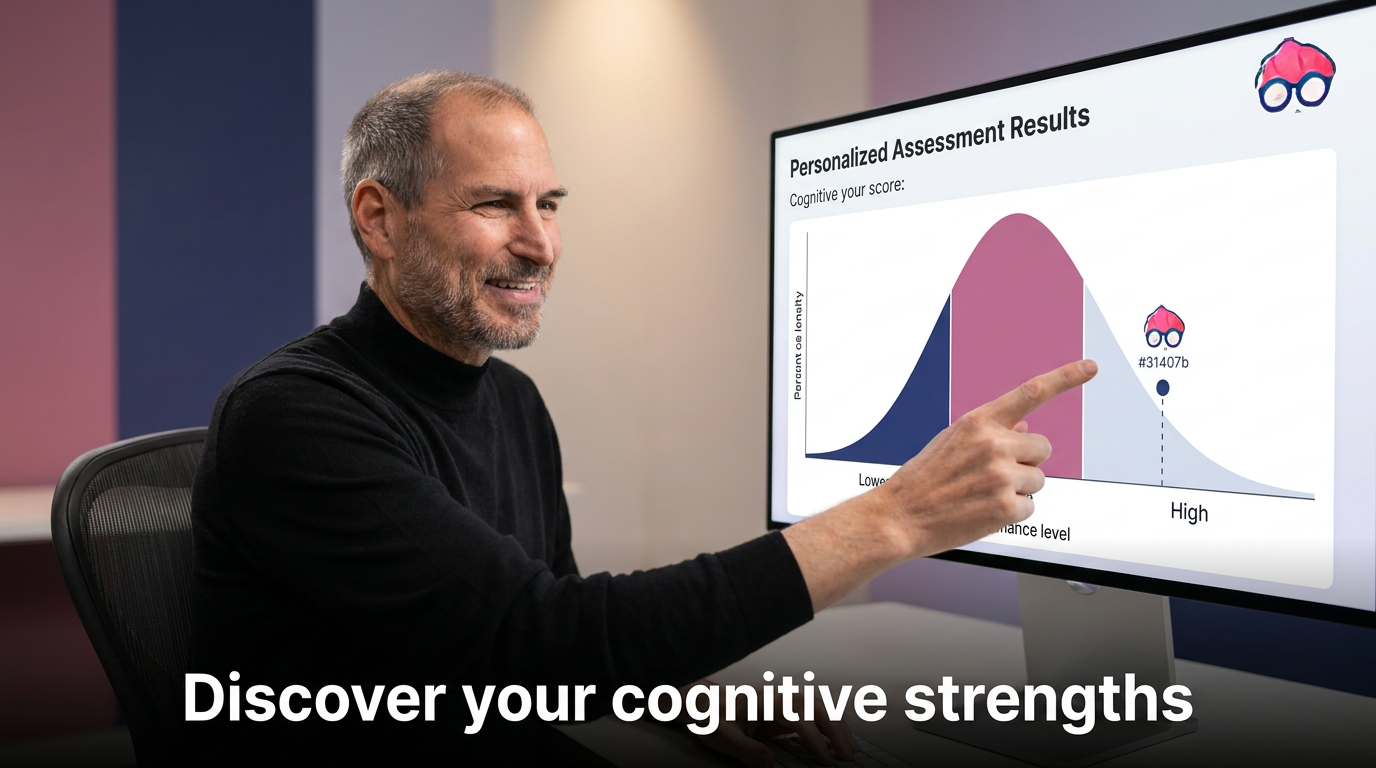
All IQ scoring is built on a statistical curve.
How IQ Distributions Work
- Average IQ: 100 (by definition)
- Standard deviation: 15 points
- Scores distribute normally (bell curve)
- 68% score between 85-115
- 95% score between 70-130
What This Means
Scoring 100 = exactly average. Scoring 115 = above average. Scoring 130 = top 2%. Most variation is normal. Scoring 110 vs 105 is meaningless. Scoring 120 vs 100 is real difference.
IQ Score Ranges
| Score | Population | Classification | Meaning |
| Below 70 | 1% | Significantly below | Cognitive challenges, may need support |
| 70-84 | 7% | Below average | Some struggle with abstract reasoning |
| 85-100 | 27% | Average (lower) | Normal cognitive ability |
| 100-115 | 27% | Average (upper) | Above average capability |
| 115-130 | 9% | Very superior | Top 10% cognitively |
| 130+ | 1-2% | Genius | Exceptional ability |
Important Context
- IQ relative to your age group
- Cultural factors influence scores
- Score is snapshot (sleep, mood affect it)
- IQ explains 25-30% of career success
Percentile Scores (More Meaningful)
Here’s what most people get wrong:
The Raw Number Misleads
People focus on “I got 115” versus “120.” The 5-point difference feels significant but statistically means almost nothing.
The Percentile Matters
Percentile tells you what percentage scored lower:
- 50th percentile = middle (half above, half below)
- 75th percentile = higher than 3 out of 4
- 90th percentile = higher than 9 out of 10
- 95th percentile = higher than 19 out of 20
- 99th percentile = higher than 99 out of 100
Practical Difference
You score 107 (64th percentile) vs friend scores 105 (63rd percentile). The 2-point difference is noise. The percentile is essentially identical. But people obsess over 2-point difference.
Better Approach: Look at percentile, not raw score.
Subscores Matter
Professional tests break down IQ into subscales:
Common Subscales
- Verbal Comprehension (understanding words, language)
- Perceptual Reasoning (visual-spatial, problem-solving)
- Working Memory (holding and manipulating information)
- Processing Speed (how quickly you work)
Why They Matter
Your overall IQ might be 115, but: – Verbal Comprehension: 125 – Perceptual Reasoning: 108 – Working Memory: 110 – Processing Speed: 98
This profile means: excellent with language, average on processing speed. Affects: – What careers fit (prefer writing/analysis? Not speed-required roles) – How you learn (need time to process) – Development focus (processing speed development more valuable)
Look at the Whole Profile
The overall number matters less than your strength profile.
What IQ Predicts (And Doesn’t)
What IQ Predicts Well
- Academic performance (r = 0.7): High IQ correlates with school success
- Job performance in knowledge work (r = 0.5): Reasoning helps complex jobs
- Income (r = 0.3-0.4): Higher IQ = higher income (but weak)
- Longevity (r = 0.3): Higher IQ = slightly longer life
What IQ Doesn’t Predict
- Career success (IQ explains 25% at most; personality, skills, luck matter more)
- Life satisfaction (r = 0.1): IQ barely correlates with happiness
- Relationships (r = 0.0): IQ doesn’t predict good relationships
- Leadership effectiveness (r = 0.2): Some leader roles need IQ, many don’t
- Creativity (r = 0.2): IQ and creativity somewhat related but not identical
- Emotional intelligence (r = 0.0): Completely different
Key Insight
IQ is important but incomplete. You need: – IQ (how you think) – Personality (how you interact) – Skills (what you can do) – Motivation (whether you care) – Emotional intelligence (relationship management) – Luck (being in right place, right time)
High IQ without motivation goes nowhere. Average IQ with drive gets further.
IQ Score Stability
In Adulthood
- Relatively stable (±5 points year-to-year)
- Won’t dramatically change without major brain injury
- Some components change: processing speed declines with age; knowledge increases
Specific Changes with Age
- Processing Speed: Peaks in 20s, declines slowly after 30
- Crystallized Intelligence: Peaks in 50s-60s
- Fluid Intelligence: Relatively stable then slowly declines
- Overall IQ: Peaks 25-30, very slowly declines
Interventions That Help (Slightly)
- Cognitive training (chess, puzzles): 2-3 point improvement
- Exercise: Maintains processing speed
- Sleep: Critical for cognition
- Learning new skills: Maintains cognitive flexibility
- Staying engaged: Better than isolation
These modestly improve scores, not dramatically change.
Retesting Reality
If you retake same test 2-3 years later: – Same ±5 points: Normal, nothing changed – Improved 10-15 points: Practice effect or better conditions – Decreased 10+: Test conditions, declining health, or measurement error
Don’t obsess over year-to-year changes.
Using Your IQ Score Meaningfully
For Career Planning
- Helps identify fields requiring reasoning (engineering, research, law)
- Combine with personality test for actual fit
- Use subscores: If processing speed is low, avoid fast-paced roles
For Understanding Yourself
- How do you naturally think?
- Where naturally strong?
- Where need support?
For Education Decisions
- Helps predict academic success
- Very high IQ might benefit from advanced programs
- Below-average might benefit from specialized instruction
- Combine with motivation
For Identifying Giftedness (Children)
- IQ 130+ usually qualifies for gifted programs
- But giftedness isn’t just IQ (achievement, creativity matter)
- High-IQ kids need appropriate challenge
What NOT to Do
- Don’t use to judge yourself or others’ worth
- Don’t assume it predicts career success
- Don’t let it limit your aspirations
- Don’t obsess over small differences
- Don’t compare to others’ scores
The score is data. Useful data about one type of thinking, not your overall worth.
Common Misinterpretations
Misinterpretation 1: “I scored 115, so I’m smart”
Better: “I score above average on reasoning tests.”
Misinterpretation 2: “My friend scored 112 and me 120, so I’m smarter”
Better: “We’re both well above average; small differences are probably measurement noise.”
Misinterpretation 3: “High IQ guarantees success”
Better: “High IQ helps in knowledge-intensive careers but doesn’t guarantee success.”
Misinterpretation 4: “My IQ never changes”
Better: “My IQ is relatively stable but can vary 5-10 points based on conditions.”
Misinterpretation 5: “Low IQ means I can’t succeed”
Better: “IQ is one factor among many; many with average IQ outachieve high-IQ people through effort.”
Next Steps
Got your IQ score?
Step 1: Take Complementary Tests
[Mindaura Personality Assessment | /personality-test] shows how you interact. [Career Aptitude Test | /career-assessment] shows what careers match.
Step 2: Look at Subscores
Analyze your strength profile.
Step 3: Compare Percentile, Not Raw Score
Focus on “I’m in top 15%” not “I scored 120.”
Step 4: Plan Based on Real Insights
Use IQ + personality + career for actual decisions.
Step 5: Remember the Bigger Picture
IQ is one component. Personality, skills, motivation, and EQ matter more for success.
Conclusion
IQ scores feel definitive—one number defining your thinking. But understanding requires context: percentiles, subscores, measurement error, what scores predict and what they don’t.
The real power isn’t in knowing your number. It’s understanding your cognitive profile and using that for better decisions about career, learning, and self-development.
[Understand your complete profile with Mindaura’s assessment | /iq-test]—combining IQ, personality, and career gives real actionable insights.
Your mind is more complex than a single score. Understand it properly.
FAQ (10 Questions)
1. What does an IQ score of 100 mean?
Exactly average by definition. IQ designed so 100 is the mean. About 25% score higher and 25% lower in 100-115 range. You’re typical, not unintelligent.
2. Is an IQ of 120 considered intelligent?
Yes, above average—about 91st percentile, meaning you score higher than 91 out of 100 people. Above-average reasoning ability. But “intelligent” is loaded—IQ measures one type of thinking, not creativity, emotional intelligence, or practical wisdom.
3. What IQ score is considered genius?
Traditionally 140+. But somewhat arbitrary. 130+ already qualifies for “gifted.” IQ alone doesn’t determine genius (Mozart had high IQ; genius comes from IQ + practice + environment).
4. How much does IQ vary between test attempts?
Professional tests typically vary ±5 points when retaken under similar conditions. 5-10 point difference: Normal variation. 10-15 points: Likely reflects test conditions (tiredness, stress). 20+ points: Probably different test type or environment.
5. Can your IQ improve with practice?
Relatively stable, but cognitive training (chess, puzzles) can improve score 2-3 points. Better health (sleep, exercise) helps maintain IQ. These are modest improvements, not dramatic changes.
6. What percentile is considered high IQ?
Generally: 90th percentile (IQ ~120) is high. 95th percentile (IQ ~130) is very high. 99th percentile (IQ ~145) is exceptionally high. Percentiles more meaningful than raw scores.
7. Is IQ score different for different ages?
IQ tests age-normalized, comparing you to your age group. An 8-year-old and 50-year-old with IQ 110 both score equally high for their age. However: Processing speed naturally declines with age; knowledge (crystallized intelligence) increases.
8. What does standard deviation mean in IQ testing?
One standard deviation in IQ is 15 points. About 68% score within one standard deviation of 100 (between 85-115). Small differences (5-10 points) are statistically meaningless.
9. Should I retake an IQ test to verify results?
Only after 6+ months (avoid practice effect). If you retake and get similar percentile, you’re consistent. Getting different results on different tests is normal.
10. What should I actually do with my IQ score?
Use: Understanding cognitive strengths/weaknesses, informed career decisions, learning style, understanding natural abilities. Don’t use: Judge yourself/others, predict success/failure, limit ambitions. It’s data about one type of thinking, not your overall worth.
INTERNAL LINKS
• Ultimate IQ Testing Guide
• Personality Assessment
• Career Aptitude Test
• IQ vs ADHD
EXTERNAL LINKS
• IQ Bell Curve
• APA on IQ