
Online IQ testing ranges from genuinely validated assessments to scored entertainment quizzes, and the gap between them is enormous. A well-built online test can estimate your cognitive ability closely enough to be useful. A viral quiz that hands everyone a flattering number cannot.
This guide explains how the three tiers of online IQ testing differ. It covers what the research says about accuracy. And it shows you how to tell a real assessment from a scored quiz.
The IQ Test Free is a 39-question multiple-choice assessment. Most people finish in about 13 minutes. You do not need an account to start, and your score is worked out the moment you submit.
- Questions
- 39
- Time
- 13 min
- Format
- Multiple choice
- Cost
- Free to take
How the IQ Test Free works
- Start the test below. All 39 questions run on this page.
- Work through the questions one at a time. You can go back and change any answer before you submit.
- A progress bar tracks how far you have got. Set aside about 13 minutes.
- Enter your email on the last screen. That is the address your results are sent to and saved under.
- Your report is ready as soon as you submit. There is no waiting period.
Example questions
How many times you subtract 5 from 25?
- 3
- 5
- 4
- 6
- 1
You pass the person in 3rd place. What place are you?
- 1
- 4
- 3
- 2
- 5
How many corners does a cube have?
- 6
- 4
- 8
- 5
- 7
Frequently asked questions
How long does the IQ Test Free take?
About 13 minutes. There are 39 questions and most people work through roughly three of them a minute. If you stop partway, your progress stays in the browser you started in, so you can come back and finish.
How many questions are in the IQ Test Free?
39, and all of them are on this page. There is no longer version of the test held back behind a payment.
Is the IQ Test Free free?
Taking the IQ Test Free is free and needs no payment details. The full written report, with the score breakdown, comparisons and recommendations, is a paid upgrade. You see a summary of your result first, so you know what is in the report before deciding whether to buy it.
Do I need to create an account?
Not to start. You answer the questions first, then enter an email on the last screen. That address is what your results are attached to. There is no password step in front of the test.
Is the IQ Test Free scientifically valid?
It uses established cognitive testing methods and gives a reasonable indication of where you sit. It is not a clinical instrument and it is not a diagnosis. A supervised battery administered by a psychologist, such as the WAIS-IV, remains the standard when a score carries real consequences. Treat the number here as a starting point, not a verdict.
Can I take the IQ Test Free more than once?
Yes. Scores move between attempts. Sleep, time of day, caffeine and simple familiarity with the format all shift the number, usually by a few points. If you want to compare two attempts, leave a few weeks between them and take both under similar conditions.
What happens to my answers?
They are stored against your account so you can reopen your report later and compare attempts. Individual answers are never published, and no other user can see your results.
Your test is being prepared…

Disagree
Agree
How to answer
Do you want to confirm your answers? You will not be able to edit them after validation.
Loading Test...
Take your time. Accuracy matters more than speed.
The next questions focus on logic and patterns.
Your score is based on every answer, so stay focused to the end.
You have answered % of the questions. Just more until your IQ score is ready.
Your IQ report reveals hidden strengths and areas for growth. A powerful tool for unlocking your potential.
Your score is based on every answer, so stay focused to the end.
In this guide: online IQ testing
- What Online IQ Testing Actually Measures
- The Three Tiers of Online IQ Testing
- How Accurate Is Online IQ Testing?
- Online IQ Test Comparison
- How to Choose an Online IQ Test
- What Your Score Actually Means
- Why Scores Need Re-Norming
- How to Get an Accurate Result
- What Happens to Your Data
- When You Need a Professional Assessment Instead
- Frequently Asked Questions
- Conclusion
What Online IQ Testing Actually Measures
An IQ test does not measure how much you know. It measures how efficiently you reason with unfamiliar information.
That distinction matters. Someone with deep expertise in one field can score in the middle of the range. Someone with modest formal education can score high. The test targets reasoning, not knowledge.
Most well-built assessments sample several cognitive domains rather than one:
- Logical reasoning: spotting patterns and abstract relationships without prior knowledge.
- Verbal reasoning: drawing conclusions from written information.
- Spatial reasoning: mentally rotating and comparing visual information.
- Working memory: holding and manipulating information in real time.
- Processing speed: how quickly you work accurately under mild time pressure.
The number of domains a test covers is the single clearest quality signal you can check before taking it. A test that only shows you shape sequences is measuring one narrow skill and calling it intelligence.
For more on how these abilities separate into different kinds of thinking, see our breakdown of fluid vs crystallized intelligence.
What IQ Testing Does Not Measure
This list matters as much as the one above. An IQ score says nothing about:
- Creativity and original thinking.
- Emotional intelligence.
- Practical judgment and common sense.
- Motivation, discipline, and persistence.
- Social skill and leadership.
Cognitive ability is one input among many. Two people with the same score routinely lead very different lives. That is the point our piece on high IQ problems nobody talks about covers in depth.
The Three Tiers of Online IQ Testing
Nearly every test you will encounter falls into one of three tiers. Knowing which tier you are looking at tells you what the result is worth.
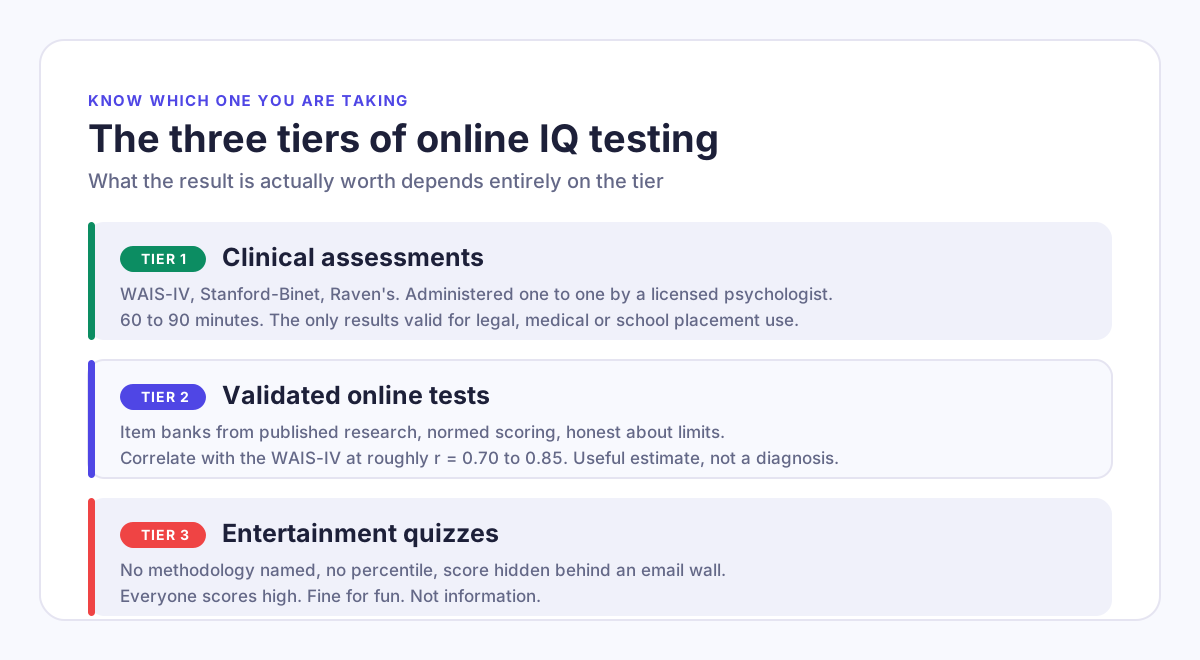
Tier 1: Clinical assessments
These are administered one-on-one by a licensed psychologist. They are not really online tests at all, though some now include digital components.
The WAIS-IV is the adult standard. It runs 60 to 90 minutes and is normed on a stratified sample of roughly 2,200 US adults. The Stanford-Binet is used widely for giftedness identification in children. Raven’s Progressive Matrices measures non-verbal reasoning through pattern puzzles, which makes it useful across language backgrounds.
These are the only results accepted for legal documentation, disability claims, or formal school placement. They also cost several hundred dollars and require appointments.
Tier 2: Validated online assessments
This tier uses item banks drawn from published psychometric research, applies normed scoring, and is transparent about its limits.
The key marker is whether the test references a real methodology. Many reputable free tests draw on ICAR, the International Cognitive Ability Resource, an open-source peer-reviewed bank of cognitive items used in academic research.
A Tier 2 test gives you a genuinely useful estimate. It does not replace a clinical assessment, and any honest provider says so.
Tier 3: Entertainment quizzes
These are built for sharing, not measuring. The signatures are easy to spot once you know them:
- Everyone seems to score unusually high.
- No methodology is described anywhere on the site.
- The score appears only after an email wall or payment.
- Questions are trivia or general knowledge rather than reasoning.
- No mention of norming, percentiles, or margin of error.
There is nothing wrong with taking one for fun. The problem is treating the number as information.
How Accurate Is Online IQ Testing?
This is the question that matters, and it has a real answer rather than a marketing one.
Research comparing ICAR-based item banks against the WAIS-IV found correlations in the range of r = 0.70 to 0.85 (Young & Keith, 2020). That is a strong relationship for an instrument you can complete for free in about fifteen minutes.
What that number means in practice: a good online test will usually place you in the right band. It will be less precise about your exact score than a clinical assessment would be.
The real gap between online and clinical testing is not average accuracy across a population. It is individual precision, standardized administration conditions, and a trained clinician’s ability to notice when something is affecting your performance.
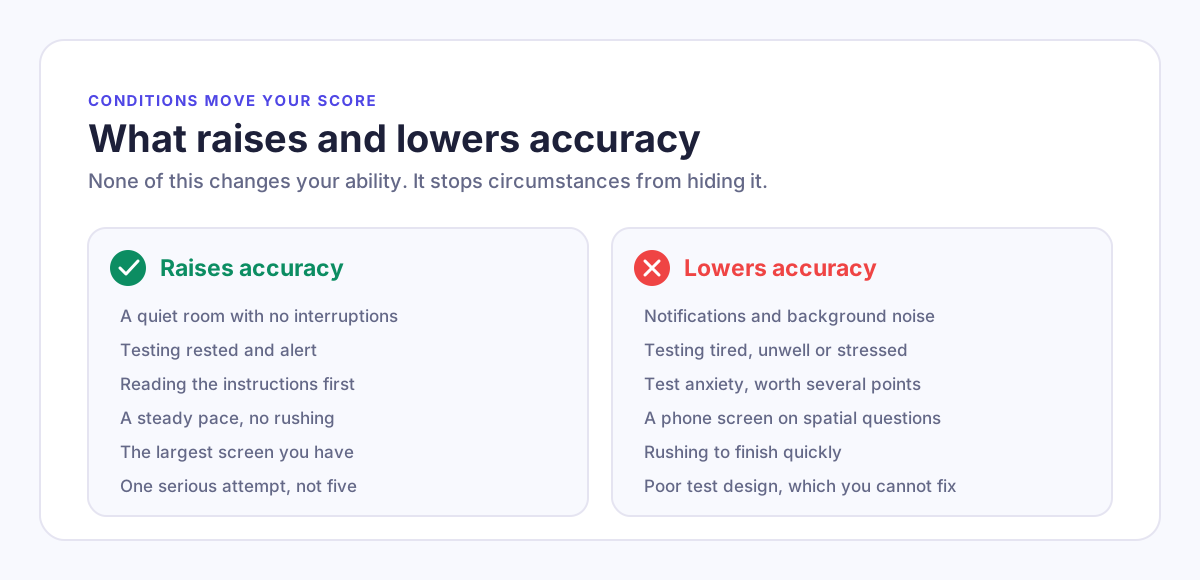
What raises accuracy
- A quiet environment with no interruptions.
- Testing when rested and alert, usually earlier in the day.
- Reading instructions properly before starting.
- Working at a steady pace instead of rushing.
What lowers accuracy
- Notifications, background noise, and interruptions.
- Testing while tired, unwell, or stressed.
- Test anxiety, which can cost several points on its own.
- A small screen on questions that require comparing shapes.
- Poor test design, which no amount of preparation fixes.
The practice effect
Retake the same test soon after your first attempt and you will usually score higher. That improvement is familiarity with the items, not a change in ability.
This is why psychometricians treat a first serious attempt as the most meaningful one. Leaving a long gap between attempts gives you a cleaner comparison.
Online IQ Test Comparison
Specifications as published by each provider at the time of writing. Question counts and durations change, so check before you commit your time.
Platform Comparison
How the main free online IQ tests compare
Domains covered is the clearest quality signal in this table.
For a direct head-to-head on a paid platform, see our Mindaura vs BrainManager comparison.
How to Choose an Online IQ Test
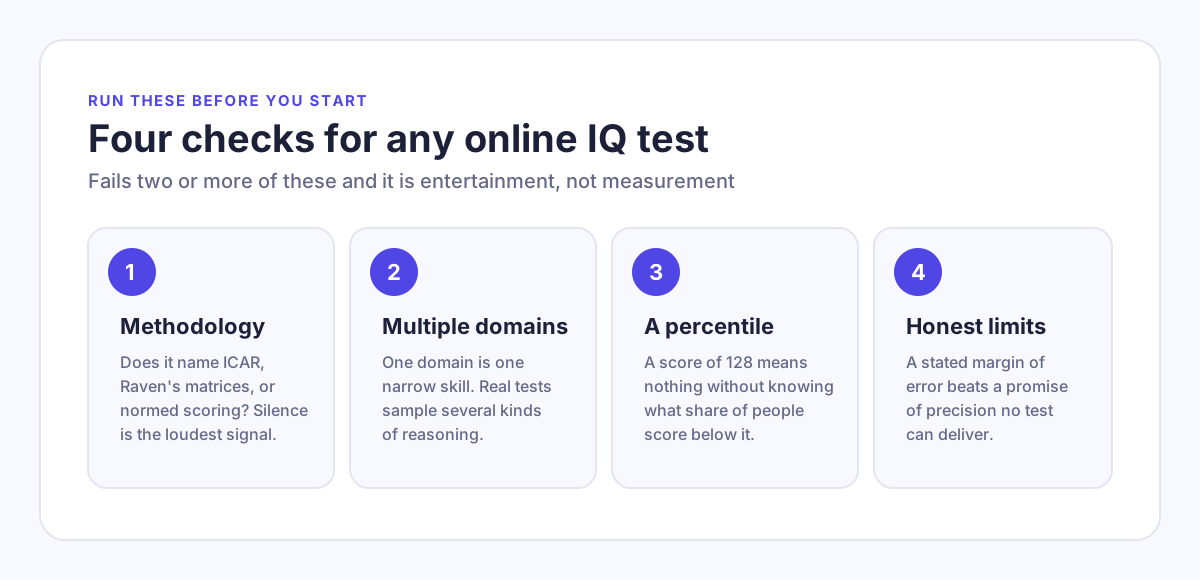
Four checks separate a real assessment from a scored quiz. Run them before you start, not after you get a number.
- Does it name a methodology? Look for ICAR, Raven’s-style matrices, or an explicit reference to normed scoring. Silence here is the loudest signal in this list.
- Does it measure more than one domain? A single-domain test measures one narrow skill. Real assessments sample several.
- Does it give you a percentile, not just a number? A score of 128 means nothing without knowing what share of people score below it.
- Is it honest about limits? A provider that states a margin of error is more trustworthy than one promising precision it cannot deliver.
A test that passes all four is worth your fifteen minutes. One that fails two or more is entertainment.
For a deeper look at what separates credible tests from clickbait, see are online IQ tests accurate.
What Your Score Actually Means
Every major IQ scale is built around the same statistical shape. The mean is 100 and one standard deviation is 15 points.
That single design choice is what lets any raw score become a classification and a percentile. About 68% of people score between 85 and 115. Roughly 95% score between 70 and 130.
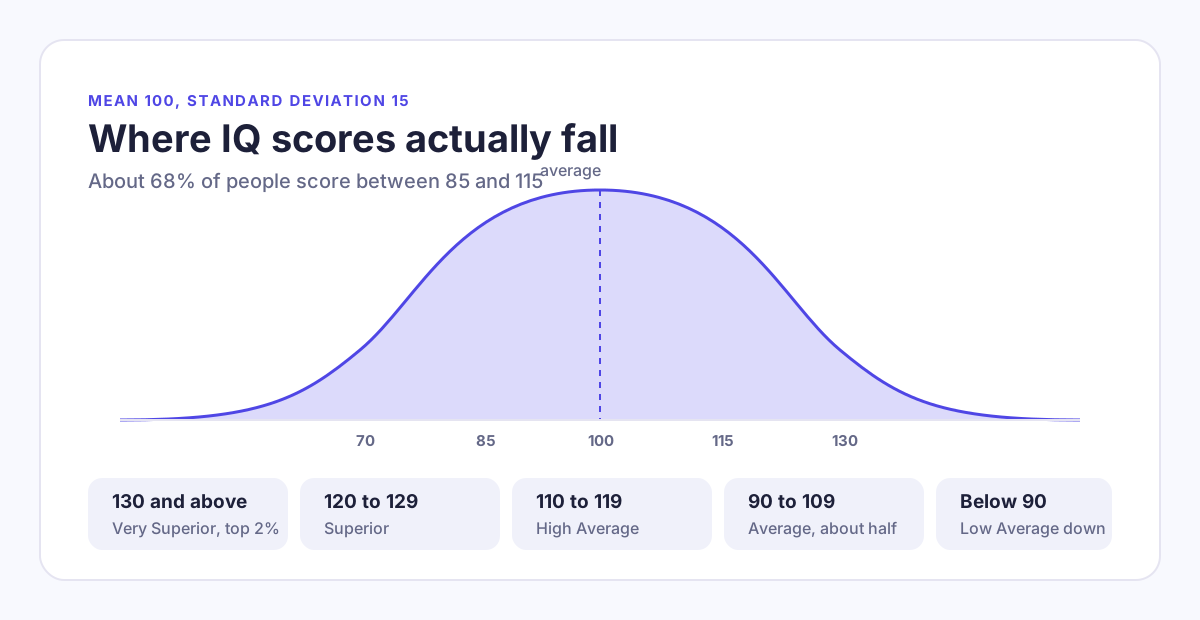
Here are the standard WAIS-IV bands in short form:
- 130 and above: Very Superior, top 2%.
- 120 to 129: Superior.
- 110 to 119: High Average.
- 90 to 109: Average, where roughly half the population sits.
- 80 to 89: Low Average.
- 70 to 79: Borderline.
- Below 70: Extremely Low.
Your score is also relative to your age group, not an absolute measure. And it is a snapshot. Sleep, stress, and mood all move it within a few points on any given day.
For the full percentile breakdown, see our IQ score chart. For what a specific number means in practice, see how to interpret your IQ score. If your result landed above 130, our guide to what qualifies as a gifted IQ score covers the threshold question properly.
Why Scores Need Re-Norming
A detail most online tests never mention: an IQ score only means something against a current reference group.
Raw scores rose by roughly 3 points per decade across most of the twentieth century, a pattern named the Flynn effect after researcher James Flynn. Test publishers re-norm their scales periodically to keep the population average anchored at 100.
The gains concentrated in abstract reasoning tasks rather than vocabulary or general knowledge. That suggests the rise reflects growing familiarity with test-taking itself, more schooling, and better nutrition, rather than a genuine jump in underlying intelligence. In several developed countries the trend has slowed or reversed since the 1990s (Bratsberg & Rogeberg, 2018).
This matters when you are choosing a test. A platform using a decades-old norm group will hand you an inflated number. Ask when the scoring was last calibrated, and treat any provider that cannot answer as a Tier 3 quiz.
How to Get an Accurate Result
Your result is only as good as the conditions you take the test in. None of this raises your underlying ability. It just stops circumstances from hiding it.
Before you start
- Sleep properly the night before. Working memory is the first thing to suffer after a bad night.
- Test when you are naturally most alert. For most adults that is late morning.
- Set aside about twenty uninterrupted minutes.
- Use the largest screen available. Spatial questions are harder on a phone.
While you work through it
- Silence your phone and close other tabs.
- Answer at a steady pace. Do not rush, but do not freeze on one item.
- Make your best guess and move on when you are unsure.
- Stay calm. Anxiety costs real points and adds nothing.
Afterwards
- Read the percentile, not just the number.
- Treat the result as a range rather than a precise figure.
- Leave a long gap before retesting, so familiarity does not inflate the second attempt.
Our full walkthrough on how to prepare for an IQ test goes further, and practice IQ questions lets you see the format before committing.
What Happens to Your Data
Online IQ testing is a data transaction, and most providers are vague about it. Three questions are worth asking before you start.
Are your answers scored in the browser or on a server?
Some tests score entirely on your device, so your responses never leave it. Others send answers to a server, which is what allows saved reports and progress tracking over time. Neither is wrong. You just deserve to know which one you are using.
Is an email required, and what is it used for?
This is where most free tests earn their reputation. A test that hides your score behind a signup form after you have done the work is using the score as bait.
Being direct about our own position. The Mindaura test asks for your name and email on the results step. That is how your report is delivered and saved, so you can return to it later. You answer all 39 questions before that point. Several competitors listed above require no email at all. If that matters more to you than a saved report, one of those is the better choice.
Can you delete your result?
Any provider operating properly will let you request deletion. If a site offers no route to remove your data, that tells you how it views the people taking its test.
When You Need a Professional Assessment Instead
Online testing is the wrong tool for some situations. Go to a licensed psychologist if any of these apply:
- You need documentation for legal, medical, or disability purposes.
- You are seeking formal school placement or a giftedness determination for a child.
- There is a history of learning difficulty that needs proper evaluation.
- The result will inform a significant clinical decision.
An online test is sufficient when you are curious about where you stand, exploring career direction, or establishing a personal baseline. It costs nothing and takes minutes rather than appointments.
No online assessment, including ours, is a diagnostic instrument. Treat any result as a starting point for reflection.
Frequently Asked Questions
Is online IQ testing accurate?
What is the ICAR framework?
How long should an online IQ test take?
Can you improve your IQ score by practising?
Why do free IQ tests often give high scores?
What is a good IQ score?
How often can you retake an IQ test?
Do online IQ tests work on a phone?
Is an online IQ test valid for Mensa or school placement?
What is the difference between an IQ test and an aptitude test?
Conclusion
Online IQ testing is genuinely useful when the test is built properly and honest about what it cannot do. The three-tier split is the thing to remember. Clinical assessments for decisions with weight, validated online tests for insight, and entertainment quizzes for nothing at all.
Run the four checks before you start. Name a methodology, cover several domains, report a percentile, state the limits.
Take the Mindaura free IQ test above. It is 39 questions across five cognitive domains, scored the moment you finish, with a percentile and a breakdown of where you are strongest.