Famous ISFPs dominate the history of popular music like no other personality type. Scan any serious list of famous ISFPs and it reads like a festival lineup spanning six decades: Dylan, Hendrix, Jackson, Cobain, Rihanna, Gaga, Ocean. That’s not list-maker laziness, it’s a real pattern with a real explanation in how the type’s cognitive wiring works, and it’s worth unpacking properly instead of just naming names.
Standard honesty disclaimer up front: none of these are verified test results. Public figures don’t publish MBTI scores, so every typing here is enthusiast consensus assembled from decades of interviews, documented behavior, and creative output. Some picks are near-universal, a few are genuinely argued over, and we’ll tell you which. For a deeper breakdown of the type’s core traits, 16Personalities’ ISFP profile is a widely-cited reference point.
Key Facts
- ISFP is estimated at around 8-9% of the population, one of the more common types
- Famous ISFPs cluster more heavily in music than any other type-and-field pairing in typology
- The Fi-Se stack, private values expressed through sensory craft, maps directly onto musical performance
- All typings are informal, based on public persona rather than verified results
- ISFP is most often confused with INFP and ESFP in celebrity typing
Discover what drives you.
Take the Premium MBTI and get your personalised report instantly.
Discover Yourself →⏱ 3-5 min · 🔬 Science-backed
In this guide: Famous ISFPs
Famous ISFPs in Music: The Songwriters Who Never Explained Themselves
Bob Dylan
Dylan may be the purest famous ISFP there is. Sixty years of interviews in which he refuses, sometimes with visible irritation, to explain what his songs mean, while the songs themselves carry more personal conviction than most artists manage in a lifetime. That’s the Fi-Se pattern exactly: the values are enormous and entirely private, and the only authorized channel for them is the work. His Nobel Prize reaction, near-total public silence, then a quietly brilliant lecture delivered on his own timeline, is the type in miniature.
Kurt Cobain
Cobain’s journals, published after his death, revealed what the ISFP typing always suggested: an intensely private internal value system, visceral discomfort with fame’s demand to perform an identity, and expression that only felt honest through the physical act of making music. His documented ambivalence about success, wanting the art heard, hating the machinery of visibility, is one of the clearest and saddest illustrations of the type’s authenticity drive colliding with celebrity.
Frank Ocean
The contemporary version of the same pattern. Ocean releases genre-shaping work on his own schedule, gives almost no interviews, skips the awards circuit, and lets years pass in public silence between projects. In an industry built on constant visibility, sustaining that withdrawal while remaining culturally central takes exactly the ISFP combination of firm private values and craft that speaks for itself.
Lana Del Rey
Del Rey built one of pop’s most complete aesthetic worlds, sonically, visually, atmospherically, while remaining famously interview-averse and reactive against critics’ attempts to define her. Constructing an entire sensory universe as a substitute for self-explanation is Se in service of Fi, and it’s why she’s a consensus pick.
Discover what drives you.
Take the Premium MBTI and get your personalised report instantly.
Discover Yourself →⏱ 3-5 min · 🔬 Science-backed
The Performers Who Lived in the Moment
Jimi Hendrix
Universally described by bandmates as soft-spoken and shy offstage, then completely transformed in performance. Hendrix didn’t compose at a desk, he discovered music physically, through the instrument, in real time. That gap between the quiet private person and the fully embodied performer is the classic ISFP performance signature.
Michael Jackson
Jackson’s typing follows the same offstage/onstage split at maximum scale: painfully shy and soft-spoken in nearly every interview, and simultaneously the most physically expressive performer of his century. For ISFPs the body is the honest channel, and no example makes that clearer.
Rihanna
Rihanna reads as the type’s more assertive register: an instinct-first career famously guided by what feels right to her rather than market logic, personal aesthetic conviction strong enough to build Fenty into an empire, and a relaxed refusal to explain or justify her choices, including walking away from music for years without apology.
Lady Gaga
A debated but recurring pick. The theatrical maximalism reads ESFP to some typists, but the through-line of Gaga’s career, radical sincerity about identity and pain underneath the constructed spectacle, and the stripped-down Joanne-era pivot toward rawness, keeps the consensus at ISFP: the costume was always in service of something privately felt.
Britney Spears and Avril Lavigne
Both are typed ISFP on the same basis: performers whose public communication was always physical and musical rather than verbal, who visibly struggled when the machinery demanded constant articulate self-presentation, and whose most convincing moments were embodied rather than explained.
Discover what drives you.
Take the Premium MBTI and get your personalised report instantly.
Discover Yourself →⏱ 3-5 min · 🔬 Science-backed
Beyond Music: Famous ISFPs Known for Presence
Princess Diana
Diana is one of the most instructive typings on the list. Her global impact came almost entirely through immediate, physical, present-moment connection, holding hands with AIDS patients when officials wouldn’t, walking through minefields, reading rooms instantly. She was, by her own account, not a speech-maker or a strategist. That is Se-grounded Fi compassion, and it’s why careful typists place her here rather than the INFJ label she often gets online.
David Beckham
Beckham’s fame ran on physical genius plus famously reserved verbal presence, and his post-football life has been built on aesthetic instinct: style, design, curated visual identity. The pattern, expression through the body and the eye rather than the argument, fits the type cleanly.
Prince Harry
A more recent consensus pick: visibly uncomfortable with institutional formality, most convincing in unscripted physical settings (the Invictus Games being the career-defining example), and ultimately willing to detonate his structured role over privately held values. Debated, but the pattern fits.
Marilyn Monroe
Monroe floats between ISFP and ESFP depending on the typist, the screen persona was pure extraverted sensing, but accounts from those close to her describe a shy, bookish, inwardly turbulent person who found the constant performance of “Marilyn” exhausting. The private-first reading is why she lands here on most careful lists.
Wolfgang Amadeus Mozart
The historical anchor, and admittedly the most speculative typing on the page. The documented pattern, effortless sensory fluency in the medium, composition described as transcription of what he already heard, personal letters full of play and feeling rather than theory, fits the ISFP profile better than any alternative, which is why he appears on virtually every list despite the obvious limits of typing someone from the 18th century.
Discover what drives you.
Take the Premium MBTI and get your personalised report instantly.
Discover Yourself →⏱ 3-5 min · 🔬 Science-backed
Why So Many Famous ISFPs Are Musicians
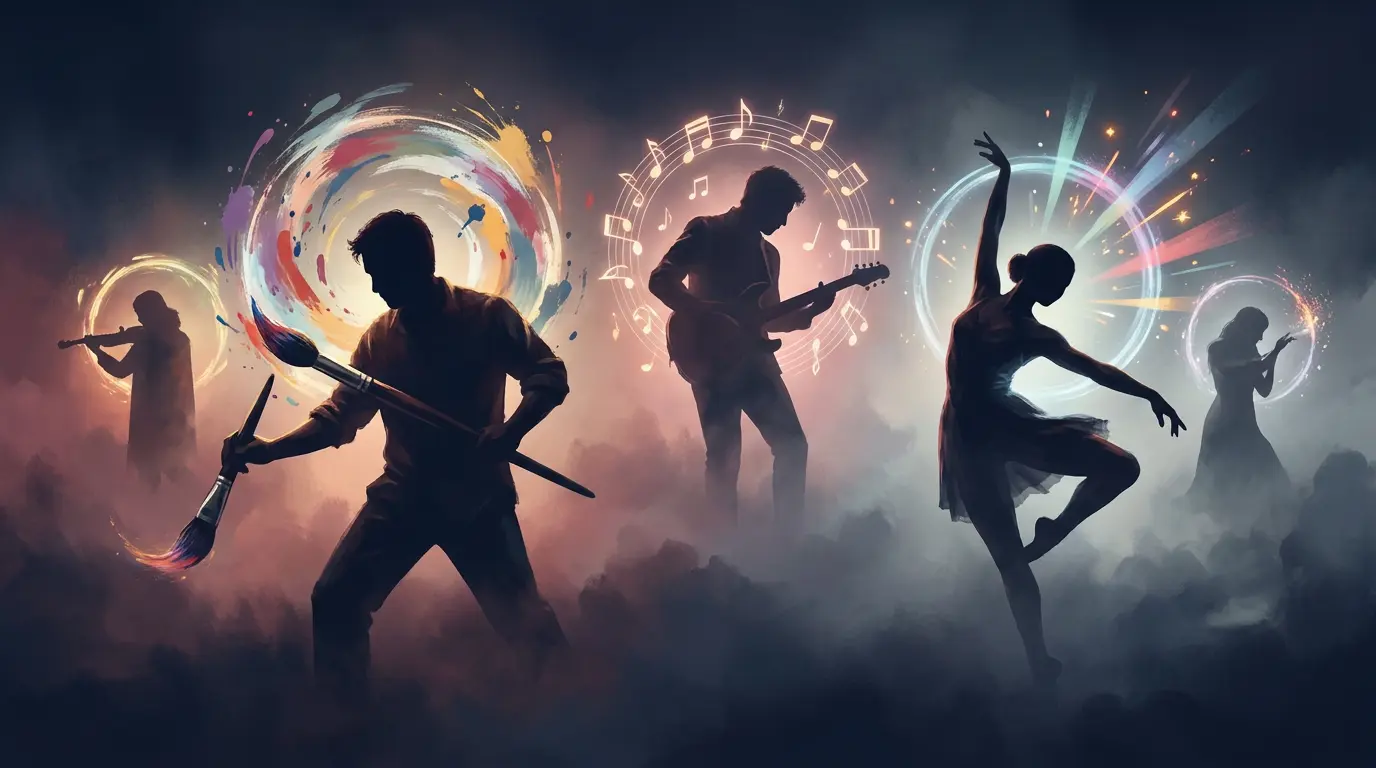
Here’s the structural explanation the name-lists skip. The ISFP stack pairs dominant Introverted Feeling, a deep private value system that resists verbal explanation, with auxiliary Extraverted Sensing, mastery of the immediate physical world. Music is the one art form that is simultaneously fully embodied (Se) and fully emotional (Fi) while requiring zero verbal self-explanation. It’s not that ISFPs choose music, it’s that music is almost purpose-built as the type’s native language. The same logic explains the list’s second tier: dance, fashion, athletics, all channels where the body and the aesthetic speak so the person doesn’t have to.
Discover what drives you.
Take the Premium MBTI and get your personalised report instantly.
Discover Yourself →⏱ 3-5 min · 🔬 Science-backed
Who Gets Wrongly Added to This List
Two common errors are worth flagging. First, verbal, explanation-heavy singer-songwriters like Taylor Swift often get placed here, but Swift’s meticulous long-range career management and highly articulate public narrative-building fit ESFJ far better than ISFP’s explanation-averse instinct. Second, introspective writers like John Lennon get pulled onto ISFP lists on vibes, when Lennon’s abstract, ideological, verbally combative style is a much cleaner INFP fit. The test is simple: famous ISFPs express through the concrete craft and resist the interview; the neighboring types are far more willing to tell you what it all means.
Frequently Asked Questions
Who is the most famous ISFP?
Why are so many famous ISFPs musicians?
Was Princess Diana an ISFP or INFJ?
Are these typings confirmed?
What do famous ISFPs have in common?
How do I know if I’m an ISFP?
Discover what drives you.
Take the Premium MBTI and get your personalised report instantly.
Discover Yourself →⏱ 3-5 min · 🔬 Science-backed
Conclusion
The famous ISFPs list is really a sixty-year demonstration of one idea: some people’s deepest convictions only come out through their hands, their bodies, and their craft, never through explanation. That’s not a limitation of the type, it’s its native language, and popular music is what it sounds like at full volume.
Take the personality test above to see if you share the wiring, and read the full ISFP personality profile for the complete picture of strengths, careers, and relationships.