
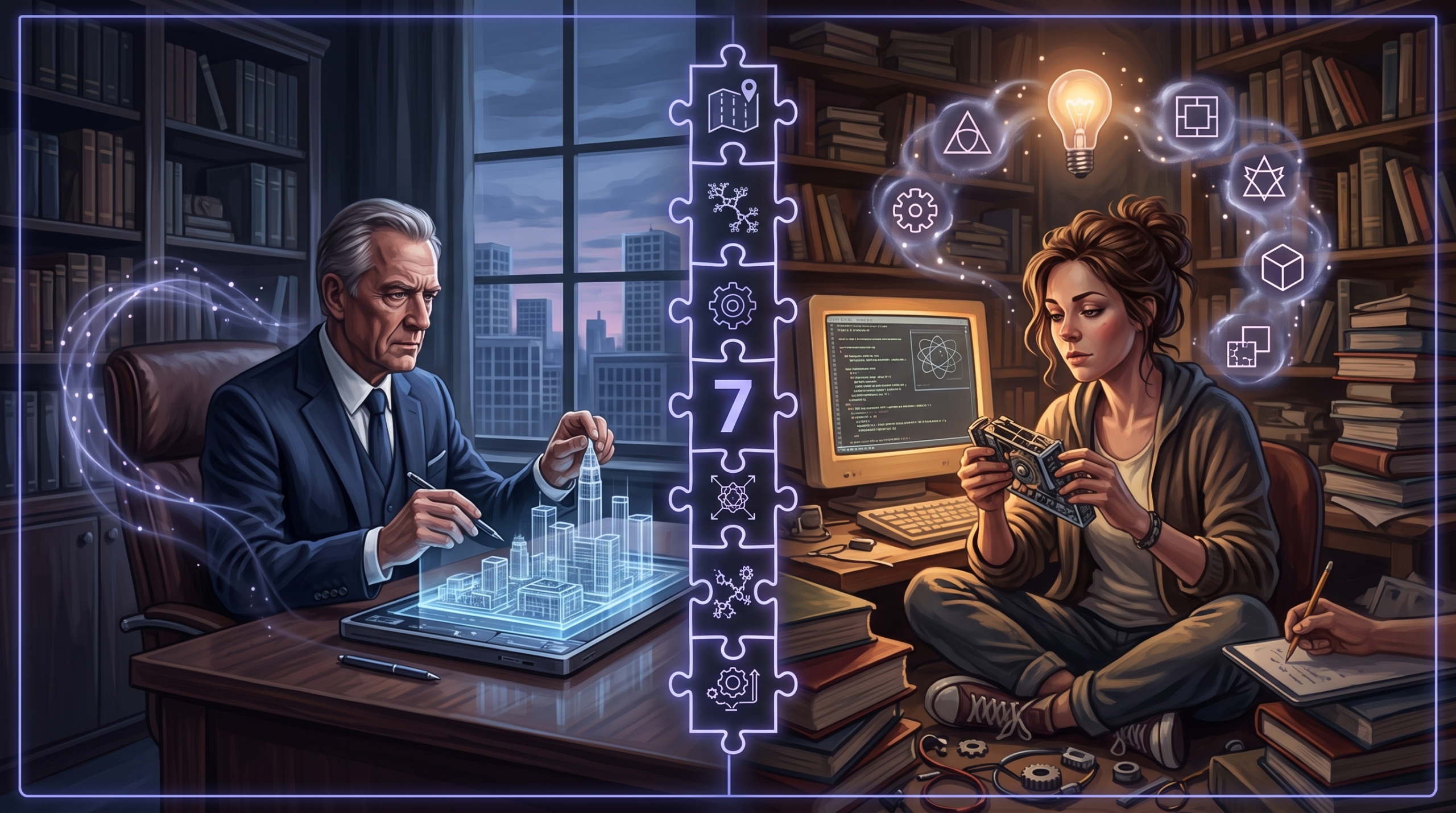
The INTJ vs INTP question catches almost everyone who lands between the two. Both are introverted, analytical, allergic to small talk and happier with a hard problem than a party. Yet they have nothing in common under the surface. Not one cognitive function sits in the same position. The resemblance is real, but it is entirely skin deep.
Quick Answer
INTJ leads with Introverted Intuition (Ni) supported by Extraverted Thinking (Te). It forms one vision of where things are heading, then organises the outside world to get there. INTP leads with Introverted Thinking (Ti) supported by Extraverted Intuition (Ne). It builds a private, internally consistent model of how things actually work, then keeps testing it against new possibilities. In short: INTJ wants the plan executed, INTP wants the logic correct. INTJ is about 2.1% of people, INTP about 3.3%.
Key Facts
- INTJ and INTP share three letters but share no cognitive function in any position
- INTJ stack: Ni, Te, Fi, Se. INTP stack: Ti, Ne, Si, Fe
- INTJ is roughly 2.1% of the population, INTP roughly 3.3%
- INTJ closes questions, INTP keeps them open, which is what the J and P letters actually describe
- INTJ is the more romanticised type online, which biases self-typing toward it

Discover what drives you.
Take the Premium MBTI and get your personalised report instantly.
Discover Yourself →In this guide: INTJ vs INTP
- The One Difference That Settles It
- INTJ vs INTP Side by Side
- Why This Mistype Happens So Often
- The Cognitive Functions Behind the Confusion
- 7 Differences You Can Actually Observe
- How Each Type Looks Under Stress
- INTJ vs INTP at Work
- INTJ vs INTP in Relationships
- Six Questions That Tell You Which You Are
- Why You Keep Getting Both Results
- If Neither Fits, Check These Types
- Frequently Asked Questions
- Conclusion
INTJ vs INTP: The One Difference That Settles It
Most comparisons list traits. Both types are logical. Both are independent. Both dislike being managed. Every item is true of both, which is exactly why people stay stuck.
The difference is structural. Each type runs four mental habits, called cognitive functions, in a fixed order. INTJ runs Ni, Te, Fi, Se. INTP runs Ti, Ne, Si, Fe.
Put those side by side and the answer appears: they share nothing in the same position. Not one function matches. Despite three identical letters, these are structurally opposite types.
Here is the practical version. Give both a messy problem. The INTJ forms a picture of how it should end, then starts organising people and resources toward that end. The INTP takes the problem apart to find out how it actually works, and is genuinely satisfied once it makes sense, whether or not anything gets built.
One is aimed at an outcome. The other is aimed at an explanation.
INTJ vs INTP Side by Side
| INTJ | INTP | |
|---|---|---|
| Nickname | The Strategic Thinker | The Curious Analyst |
| Function order | Ni, Te, Fi, Se | Ti, Ne, Si, Fe |
| Leads with | One converging vision of the future | A private model of how things work |
| Thinking is pointed | Outward, to organise the world (Te) | Inward, to build a consistent model (Ti) |
| Intuition is pointed | Inward, narrowing to one read (Ni) | Outward, branching into options (Ne) |
| Share of population | About 2.1% | About 3.3% |
| Wants organised | The external world | The internal model |
| Relationship to deadlines | Sets them, meets them | Treats them as approximate |
| Under stress | Sensory indulgence (inferior Se) | Emotional outburst (inferior Fe) |
| Ends a debate by | Deciding and moving | Refining the definition |
| Common complaint | “People will not just execute the plan” | “People want an answer before the question is clear” |
Why This Mistype Happens So Often
Three forces push people into this confusion, and none of them are about the types themselves.
Trait descriptions cannot separate them. Read any list of INTJ traits. Strategic, independent, private, sceptical, impatient with inefficiency. Now read an INTP list. Analytical, independent, private, sceptical, impatient with sloppy reasoning. The same words appear because both types are introverted and thinking-oriented. Trait lists describe output, and both types output similar behaviour.
The J and P letters are widely misread. Most people assume J means tidy and P means messy. It does not. Judging and Perceiving describe how you handle the outside world, not how organised you are. A chaotic INTJ with a cluttered desk is still a J, because they still want questions closed and decisions made. A meticulous INTP is still a P, because they want the question kept open until the logic is airtight.
There is a real bias toward INTJ. INTJ has been romanticised heavily online, often framed as the mastermind or the rarest genius type. That reputation pulls self-typing toward it. If you are choosing between the two and one of them sounds more flattering, that is a reason to be more sceptical, not less. Type is not a ranking.
The Cognitive Functions Behind the Confusion
This is where the INTJ vs INTP answer actually lives. Read it once slowly and the rest of the article becomes obvious.
INTJ leads with Introverted Intuition (Ni)
Ni absorbs patterns over time and produces a single conclusion. It converges. An INTJ often knows where something is heading without being able to show the working, because the processing happened quietly and arrived finished.
The support function, Extraverted Thinking, then takes that conclusion and organises reality around it: build the schedule, assign the work, remove the obstacle. This is why INTJs come across as decisive and directive even when they are deeply introverted.
INTP leads with Introverted Thinking (Ti)
Ti builds a private framework and checks everything against it for internal consistency. It does not care whether a conclusion is useful. It cares whether it is correct.
The support function, Extraverted Intuition, then keeps feeding that framework new possibilities: what if the assumption is wrong, what else could explain this, what about the edge case. Ne diverges where Ni converges, which is why INTPs generate options while INTJs narrow them.
Why this produces the mistype
Both end up looking like a quiet person with strong opinions and unusual analytical range. But the INTJ got there by forming a vision and organising toward it. The INTP got there by dismantling the problem until it made sense.
A trait list cannot tell those apart. A function stack can. Our guide to the 16 personality types lays out all sixteen stacks side by side if you want the full map.
7 Differences You Can Actually Observe
These are behavioural, not theoretical. You can watch for them in yourself or in someone else within a single afternoon.
- 1. Closing versus opening. An INTJ is uncomfortable until a question is settled. An INTP is uncomfortable when a question is settled too early. Watch what each does with an unresolved decision.
- 2. Where the mess is. INTJs want an organised external world and tolerate an unresolved internal one. INTPs want an airtight internal model and tolerate external chaos. Look at which kind of disorder actually bothers the person.
- 3. How the hunch arrives. INTJ hunches appear whole, with no traceable source. INTP hunches come from spotting an inconsistency in specific data. One feels like knowing, the other feels like noticing.
- 4. Directness. INTJs state conclusions plainly and can seem blunt. INTPs qualify heavily, because Ti keeps flagging the exceptions. “It depends” is an INTP sentence.
- 5. Reaction to being wrong. An INTJ updates the plan and moves on, often without commentary. An INTP wants to understand exactly where the reasoning broke, and will happily spend an hour on it.
- 6. Relationship to finishing. INTJs finish things because the point was the outcome. INTPs often lose interest once the problem is understood, because the point was the understanding.
- 7. What they do with knowledge. INTJs apply it to change something external. INTPs accumulate it because the map itself is the goal.
How Each Type Looks Under Stress
The fourth function is the weakest, and under prolonged stress it takes over in a clumsy, uncharacteristic way. This is often called a grip, and the two types grip in opposite directions.
An INTJ under stress falls into inferior Extraverted Sensing. The usual long-range focus collapses into the immediate physical world. That looks like binge eating, overspending, compulsive exercise, marathon television, or fixating on a small sensory detail. An INTJ who normally plans a decade ahead suddenly cannot see past this evening.
An INTP under stress falls into inferior Extraverted Feeling. The usual detachment collapses into an emotional flood that arrives without warning and often over something small. INTPs describe this as feeling hijacked, because the emotion is real but the trigger is out of proportion. It frequently comes with a sudden, uncharacteristic need for reassurance that people actually like them.
This is one of the clearest tells available, because it is hard to fake and hard to misread. Ask yourself what falls apart when you have been stretched for weeks. If the answer is your body and your routines, that points to INTJ. If the answer is your composure, that points to INTP.
INTJ vs INTP at Work
INTJs do well where they can own an outcome: strategy, systems architecture, operations, research direction, product planning, anything that involves getting a complicated thing from here to done. Te makes them effective at organising other people, which is why so many end up leading despite not seeking it.
INTPs do well where being right matters more than being fast: research, engineering, mathematics, analysis, philosophy, debugging, security, anything with a genuinely hard problem at the centre. They are often the person who finds the flaw everybody else walked past.
The clearest workplace tell: give both an ambiguous brief. The INTJ comes back with a recommendation and a sequence. The INTP comes back with a list of the ways the brief is currently incoherent.
Both share a blind spot, and it sits in their fourth function. For INTJ that is Se, so physical logistics, health and present-moment detail get neglected. For INTP that is Fe, so team morale and the social cost of being right get neglected. We map type to role fit in best careers for your personality type.
INTJ vs INTP in Relationships
Both are slow to commit, private about feelings, and uncomfortable with performed emotion. What they offer once they are in differs sharply.
An INTJ offers commitment as a decision. Once they have concluded that this is the person, the matter is closed and they act accordingly, often for decades. The friction point is that the decision was made internally and rarely gets restated out loud, so a partner can feel taken for granted while the INTJ considers the question long settled.
An INTP offers honesty and genuine acceptance. They will not pretend to feel something to keep the peace, and they rarely try to change a partner. The friction point is expression. Fi sits third and Fe sits last, so an INTP can care intensely and still say almost nothing, which reads as distance.
Neither type handles emotional conflict naturally. INTJs tend to treat it as a problem to solve. INTPs tend to go quiet and analyse. You can run any two types through our MBTI compatibility checker to see where a pairing aligns and where it will need translating.
Six Questions That Tell You Which You Are
Answer about how you actually are, not how you would like to be. Most people find four or five land clearly on one side.
- Does an open question feel like freedom or like an itch? An itch points to INTJ. Freedom points to INTP.
- Which disorder bothers you more, a messy room or a sloppy argument? Messy room points to INTJ. Sloppy argument points to INTP.
- When you are certain, can you explain how you got there? Usually not, it just arrived, points to INTJ. Usually yes, step by step, points to INTP.
- Do you say “here is what we should do” or “well, it depends”? The first points to INTJ. The second points to INTP.
- Once you understand a problem, do you still want to build the solution? Yes points to INTJ. Often no, the understanding was the point, points to INTP.
- Under weeks of stress, what breaks first? Your body, sleep and spending points to INTJ. Your composure and emotional control points to INTP.
If the answers split evenly, you are probably answering as you are at work. Professional personas are the single biggest cause of a wrong result, and both types build strong ones. Answer as you are at home with nobody watching.
Why You Keep Getting Both Results
Getting INTJ once and INTP the next time is extremely common. It is not a sign the test is broken. It is a sign of where you sit on one scale.
Judging versus Perceiving is the only letter separating these two types. If you scored near the middle on it, the test has to round you one way, and a small change in mood or question wording flips the label.
Somebody who is 51% Judging is not a stable J. They are sitting on a line. This is why preference strength matters far more than the four letters.
A result of INTJ at 53% Judging means something very different from INTJ at 82% Judging. If your report shows percentages, read them before accepting the label. We cover what type assessments can and cannot tell you in are personality tests accurate.
If Neither Fits, Check These Types
Sometimes the honest answer is that you are neither, and the pair simply captured you because both are introverted thinkers. Three types are worth checking.
ISTP shares dominant Introverted Thinking with INTP but pairs it with Extraverted Sensing rather than Extraverted Intuition. If you build precise mental models but apply them to physical, hands-on problems rather than abstract ones, ISTP fits better than INTP.
ISTJ shares the organised, decisive surface of INTJ but leads with Introverted Sensing rather than Intuition. If your certainty comes from accumulated experience and precedent rather than from a picture of the future, ISTJ is the better read.
INFJ shares dominant Introverted Intuition with INTJ but supports it with Extraverted Feeling instead of Extraverted Thinking. If you get the same whole-cloth hunches but they are about people rather than systems, look at INFJ.
For the full breakdown of each type on its own terms, see our INTJ personality type guide and INTP personality type guide. The Myers-Briggs Foundation publishes the official description of each preference pair.
Discover what drives you.
Take the Premium MBTI and get your personalised report instantly.
Discover Yourself →Frequently Asked Questions
QWhat is the main difference between INTJ and INTP?
AINTJ leads with Introverted Intuition supported by Extraverted Thinking, so it forms one vision and organises the outside world to reach it. INTP leads with Introverted Thinking supported by Extraverted Intuition, so it builds a private model of how things work and keeps testing it. They share three letters but no cognitive function in any position.
QDo INTJ and INTP share any cognitive functions?
ANo. INTJ runs Ni, Te, Fi, Se and INTP runs Ti, Ne, Si, Fe. Not one function appears in the same position, and the two stacks do not overlap at all despite the three shared letters. This is why the types feel similar from outside and operate completely differently from inside.
QIs INTJ or INTP rarer?
AINTJ is rarer. It is estimated at about 2.1% of the United States population compared with about 3.3% for INTP. Both are uncommon, and both sit well below the roughly 14% of people who share the most common type, ISFJ.
QDoes the J in INTJ mean they are more organised than INTP?
ANot in the way most people assume. Judging and Perceiving describe how you handle the outside world, not how tidy you are. Plenty of INTJs live in clutter while still needing decisions settled, and plenty of INTPs keep meticulous systems while leaving questions deliberately open.
QWhy do I keep getting INTJ and INTP on different tests?
ABecause Judging versus Perceiving is the only letter separating them, and you likely scored close to the middle on it. A near-even score has to be rounded one way, so small changes in mood or question wording flip the result. Look at your preference strength rather than the four-letter label.
QWhich is smarter, INTJ or INTP?
ANeither. Personality type does not measure intelligence and no type scores higher than another. Both types are associated with analytical thinking, which is why the question comes up, but that is a preference for how to think rather than a measure of ability.
QHow do INTJ and INTP behave differently under stress?
AAn INTJ falls into inferior Extraverted Sensing, which shows up as sensory indulgence such as binge eating, overspending or compulsive exercise. An INTP falls into inferior Extraverted Feeling, which shows up as a sudden emotional flood that is out of proportion to the trigger. The two grip in opposite directions.
QCan you be both INTJ and INTP?
ANo. The two types run entirely different cognitive functions, so you cannot run both stacks at once. What feels like being both is usually a near-even score on the Judging and Perceiving scale, or a work persona that differs from how you operate in private.
Conclusion
The INTJ vs INTP question stays confusing for as long as you compare traits, because on traits the two genuinely do look alike. It stops being confusing the moment you compare function order. INTJ converges on a vision then organises the world around it. INTP builds a model then keeps testing it. Three shared letters, zero shared functions.
If the six questions above still leave it open, the useful next step is a result that shows preference strength rather than only a label. The INTJ vs INTP call is easiest to settle once you can see how strongly you lean on Judging versus Perceiving. Take the free personality test to find out.