
An IQ of 140 sits at about the 99.6th percentile on a test with a mean of 100 and a standard deviation of 15. Only about 0.38% of people, or roughly 1 in 261, score at or above it. It is well past the gifted line of 130, but no modern test calls it genius.
Here is a worked example. Picture a large sports stadium holding 26,100 randomly chosen adults, all given the same supervised IQ test. If you score 140, only about 100 people in the whole stadium score as high as you or higher. Everyone else scores lower. To see how every score in between compares, use our IQ score chart.
Key facts, with sources
- An IQ of 140 is about 2.67 standard deviations above the mean of 100 on Wechsler-style scales.
- That is about the 99.6th percentile, or roughly 1 person in 261 (normal distribution).
- Lewis Terman’s 1916 Stanford-Binet manual labelled scores above 140 “near genius or genius” (Terman, page 79).
- The WAIS-IV full-scale IQ only runs from 40 to 160, so the top of the scale is close (Canivez, 2010).
- On a scale with a standard deviation of 24, such as the Cattell scale, 140 is only about the 95th percentile.
In this guide
- What does a score of 140 mean?
- What percentile is a score of 140?
- Is a score of 140 genius level?
- What happened to Terman’s high scorers?
- Why is a score of 140 hard to measure?
- Which high IQ societies accept a score of 140?
- Why does the scale change what a score of 140 means?
- How does a score of 140 compare with 100, 130 and 145?
- What does a score of 140 predict?
- Can you trust an online IQ of 140?
- What should you do with your IQ of 140?
- Frequently asked questions
- Sources
What does an IQ of 140 mean?
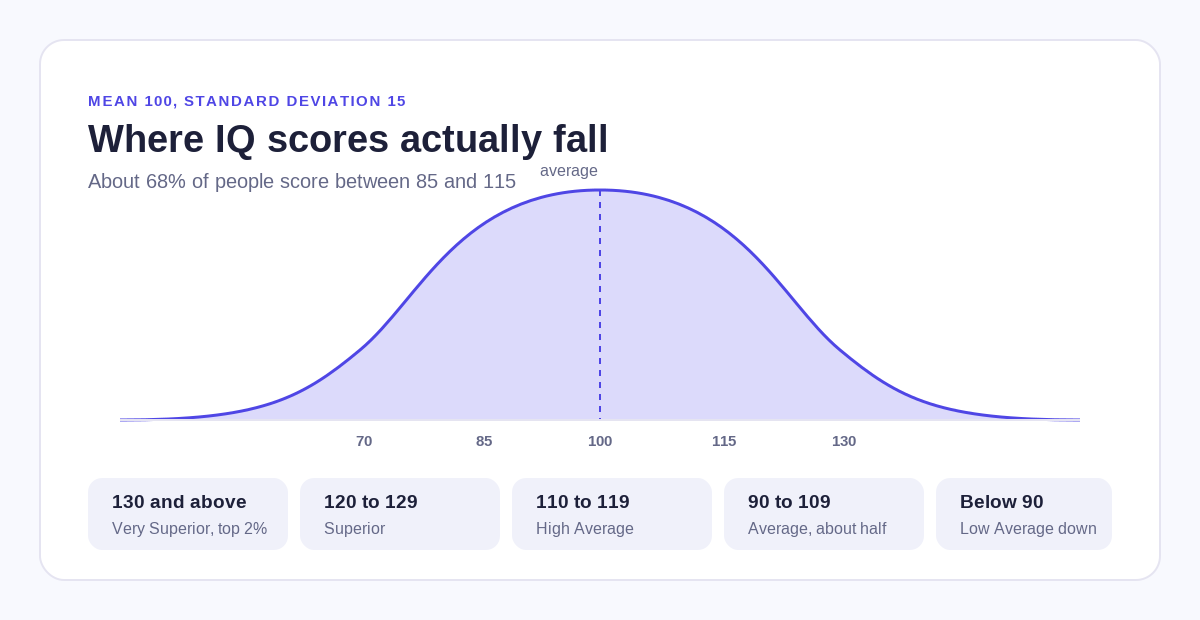
A score of 140 means you scored 40 points, or about 2.67 standard deviations, above the average for people your age. IQ scores are ranks, not counts of right answers. Modern tests fix the average at 100 and the step size at 15, so 140 marks a spot deep in the upper tail of the curve.
Unlike 130, this number has no formal gate attached to it. No major school system or society uses 140 as its entry rule. Its fame is mostly cultural. It became shorthand for exceptional intelligence because of a labelling choice made more than a century ago.
The score is also always relative to a norm group of people your age. A 12-year-old and a 50-year-old who both score 140 have each done far better than their own peers. They have not done the same raw work, and the number says nothing about what either of them knows.
The history of intelligence testing shows how these early rankings and labels were first put together.

What percentile is an IQ of 140?
A score of 140 is at about the 99.6th percentile. On a scale with a mean of 100 and a standard deviation of 15, about 99.62% of people score below it and about 0.38% score at or above it. That works out to roughly 1 person in 261, or about 4 people in every 1,000.
Rare does not mean tiny. In a city of one million adults, about 3,800 people would score at or above 140. That is enough to fill a good-sized concert hall. Most of them would look completely ordinary to you at work, in a shop or on a train.
The table shows how quickly the share of people shrinks in the upper tail. Every figure comes from the normal distribution with a mean of 100 and a standard deviation of 15.
| IQ score | Percentile | Share at or above | Roughly how common |
|---|---|---|---|
| 120 | 91st | 9.1% | 1 in 11 |
| 130 | 97.7th | 2.3% | 1 in 44 |
| 135 | 99.0th | 0.98% | 1 in 102 |
| 140 | 99.6th | 0.38% | 1 in 261 |
| 145 | 99.87th | 0.13% | 1 in 741 |
| 150 | 99.96th | 0.043% | 1 in 2,330 |
| 160 | 99.997th | 0.0032% | 1 in 31,600 |
Each step of 5 points makes a score about three times rarer in this part of the curve. You can check any other number with our IQ percentile calculator.
Is an IQ of 140 genius level?
Not in any technical sense. The link between 140 and genius comes from Lewis Terman’s 1916 manual for the Stanford-Binet. It labelled scores above 140 “near genius or genius”. No modern test manual uses that word. Current Wechsler tests describe 130 and above as “Very Superior” or “Extremely High”.
Terman’s own book was cautious. Right after the label, he wrote that intelligence tests had not been in use long enough to define genius in terms of IQ. He also called the boundaries between his groups “absolutely arbitrary, a matter of definition only”. The label stuck far more firmly than his warnings did.
There is a second catch. Terman’s 1916 IQ was a ratio of mental age to real age, not the modern deviation score. A 140 then and a 140 now are not built the same way. Today, genius usually describes work that changed a field, judged after the fact, not a test result.
How sharp is your mind?
Take the Iq Quiz Test and get your personalised report instantly.
Start the Test →What happened to Terman’s high scorers?
Terman’s group did well on average, but not in the way the genius label suggests. His long-term study of gifted California children, begun in the 1920s, produced many doctors, lawyers and PhDs. It also produced ordinary lives, ordinary problems and not a single Nobel Prize.
According to a Stanford Magazine history of the project, Terman’s core group of 643 children had IQs of 135 or higher, and the study grew to 1,528 people. Two thirds earned bachelor’s degrees, far above the national rate at the time. The group produced 97 PhDs, 57 medical doctors and 92 lawyers.
The same history reports that the group divorced, became alcoholics and died by suicide at about the national rate. Here is what the study showed in short:
- As a group, high scorers earned more degrees and higher pay than average.
- Results inside the group varied widely, from famous careers to quiet ones.
- They were no more and no less emotionally stable than other people.
- None of them won a Nobel Prize or a Pulitzer Prize.
- Two boys who were tested but not chosen, William Shockley and Luis Alvarez, both later won the Nobel Prize in Physics.
The lesson is not that testing is useless. A high score raises the odds of some good outcomes across a group. It does not pick out the most creative person in any room.
Why is an IQ of 140 hard to measure?
Scores this high are harder to pin down because tests have few items and few people at the top end. The WAIS-IV was normed on 2,200 adults, and its full-scale IQ only runs from 40 to 160. In a sample that size, only about 8 people would be expected to score 140 or more.
That matters. When the top of the norms rests on a handful of cases, small changes in raw score can move the IQ a lot. A person who answers one or two more hard items can jump several points. The same step near 100 would barely move the score.
There is also a ceiling. Once a test runs out of hard enough items, it can no longer tell a very strong performer from an even stronger one. Specialist high-range tests try to fix this, but they often have small or self-selected norm groups of their own.
So read a 140 as “somewhere in the top half percent or so”, not as a precise point.
Which high IQ societies accept an IQ of 140?
A score of 140 from an approved, supervised test clears the Mensa bar with room to spare. Mensa admits people at or above the 98th percentile, and American Mensa accepts a Wechsler full-scale IQ of 130. More selective groups exist, but a 140 usually falls just short of them.
The Triple Nine Society, for example, asks for a score 3 standard deviations above average. On a scale with a standard deviation of 15, that is 145, about the 99.87th percentile. A handful of tiny societies claim even higher cut-offs, where the ceiling problem above makes scores very hard to trust.
Mensa does not accept free online tests. Mensa International says online tests cannot be used for admission. Our Mensa IQ test guide lists the accepted tests and how to apply with prior evidence.
Why does the scale change the meaning?
Not every IQ test uses a standard deviation of 15. Older Stanford-Binet editions used 16, and the Cattell scale uses 24. On a scale with a standard deviation of 24, a score of 140 is only about 1.67 deviations above the mean. That is about the 95th percentile, or roughly 1 person in 21.
So the same three digits can mean the top 0.4% or the top 5%, depending only on the test. American Mensa’s list shows this clearly. It accepts 130 on the Wechsler tests but asks for 148 on the Cattell, because both numbers mark the same 98th percentile.
Before you compare any two scores, check these details on the report:
- The name and edition of the test.
- The standard deviation of the scale, usually 15, 16 or 24.
- The percentile rank, which is the one figure that moves cleanly between tests.
- The confidence interval, which tends to be wider far from the mean.
- The year the norms were set, since old norms tend to give higher scores.
Our IQ scale converter turns a score on one scale into its match on another.
How does 140 compare with 100, 130 and 145?
A score of 140 is 40 points above the average of 100, 10 points above the gifted line of 130 and 5 points below the 3 standard deviation mark of 145. In rarity terms, about 2.3% of people reach 130, about 0.38% reach 140 and about 0.13% reach 145.
IQ of 140 versus 130
Ten points makes a score about six times rarer, from roughly 1 in 44 to roughly 1 in 261. In daily life the gap is often hard to see. Our IQ of 130 guide covers the gifted line in detail.
IQ of 140 versus 145
On paper, 145 is nearly three times rarer than 140. But the margin of error on a supervised test is several points each way, so a measured 140 and a measured 145 are not reliably different. The gap is mostly noise.
IQ of 140 versus 100
The distance from 100 up to 140 is the same as the distance from 100 down to 60. That is a large gap. Our guide to an IQ of 100 explains what the average really means.
What does an IQ of 140 predict?
A score of 140 predicts better than average results at school and, to a lesser degree, at work. The links are moderate. Large reviews put the link with school grades near 0.5 and the link with job performance near 0.3, so most of the difference between people comes from other things.
A 2015 meta-analysis by Roth and colleagues found a corrected correlation of 0.54 between intelligence and school grades. For work, an influential 1998 review by Schmidt and Hunter put the link near 0.5. A 2022 re-analysis by Sackett and colleagues revised it to 0.31, with structured interviews higher at 0.42.
A popular idea says extra points stop mattering above about 120 or 130. Long-term data do not back that up. The Study of Mathematically Precocious Youth followed children in the top 1% of reasoning ability. Even inside that group, higher ability still predicted greater educational, career and creative achievement decades later.
Still, ability is only part of the story. Interests, effort, health, chances and timing all shape what a capable person does. The Terman results show that clearly. The score describes headroom. It is not a plan.

Can you trust an online IQ of 140?
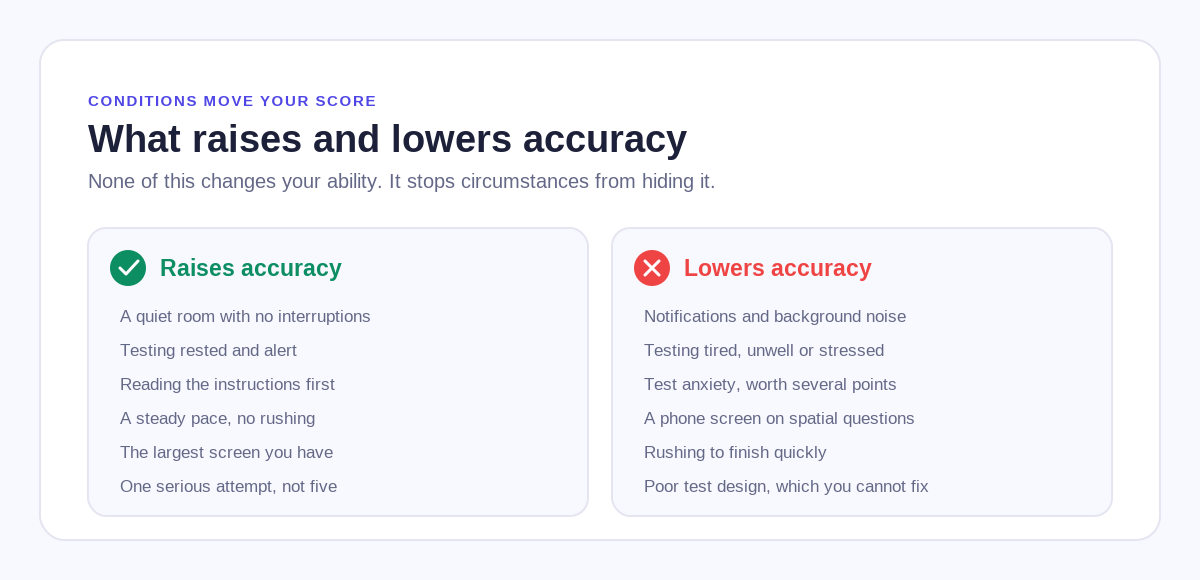
Treat an online 140 with extra care. Extreme scores are where errors pile up. Short tests, self-selected norm groups and the lack of supervision all add noise, and that noise is largest far from the average. A supervised test is the only way to confirm a score this high.
The main adult test, the WAIS-IV, is given one to one by a trained examiner. Pearson lists 60 to 90 minutes for its core subtests. Even then, the top of the scale rests on few cases. An online test cannot check for distraction, outside help or repeat attempts, and all three tend to push scores up.
Scores also move between sittings. A meta-analysis by Scharfen and colleagues found that retaking a cognitive test raised scores by about a third of a standard deviation on average, or about 5 IQ points. If you took several online tests and kept the best result, it is probably too high.
A well-built online test can still show the broad band you fall into. Our guide on whether online IQ tests are accurate explains what to look for.
Online IQ figures for famous people deserve even less trust. There is no record of Albert Einstein ever taking an IQ test, and most celebrity scores you see online have no documented source. Our guide to famous people’s IQ scores explains where those numbers come from.
How sharp is your mind?
Take the Iq Quiz Test and get your personalised report instantly.
Start the Test →What should you do with your IQ of 140?
Treat the score as a useful sign, not a title. Look at the percentile, the confidence range and the pattern across skills. Then use what you learn to choose work and problems that stretch you, because high ability helps most when it meets steady effort and real interest.
- Read it as a band. Think “top half percent or so, give or take”, not “exactly 140”.
- Check the scale. Confirm the test used a standard deviation of 15 before you compare it with others.
- Confirm it if it matters. For Mensa or school use, you need a supervised test from a qualified professional.
- Get a fresh baseline. Take the Mindaura IQ test to see where you land today, and read the result as a range.
- Look after the rest. Sleep, health and good habits shape how well you use your ability. Our guide to high IQ problems covers common pitfalls.
If you want a deeper written breakdown of your result, you can see what the full Mindaura report includes on our pricing page. For the bigger picture on gifted scores, see our guide to the gifted IQ score.
Frequently asked questions
Is an IQ of 140 good?
What percentile is an IQ of 140?
Is an IQ of 140 genius level?
How rare is an IQ of 140?
Can you join Mensa with an IQ of 140?
Does an IQ of 140 mean the same thing on every test?
Why are very high IQ scores less reliable?
How accurate is an IQ of 140 from an online test?
Sources
- Terman, L. M. (1916). The Measurement of Intelligence. Houghton Mifflin, page 79.
- Leslie, M. (2000). The vexing legacy of Lewis Terman. Stanford Magazine.
- Canivez, G. L. (2010). Review of the Wechsler Adult Intelligence Scale, Fourth Edition. Mental Measurements Yearbook.
- Pearson. Wechsler Adult Intelligence Scale, Fourth Edition.
- Pearson. WISC-V UK sample score report.
- Mensa International. Getting your IQ tested: FAQs.
- American Mensa. Qualifying test scores.
- Triple Nine Society. About the Triple Nine Society.
- Robertson, K. F., Smeets, S., Lubinski, D., and Benbow, C. P. (2010). Beyond the threshold hypothesis. Current Directions in Psychological Science, 19(6), 346 to 351.
- Roth, B., and colleagues (2015). Intelligence and school grades: a meta-analysis. Intelligence, 53, 118 to 137.
- Society for Industrial and Organizational Psychology. Is cognitive ability the best predictor of job performance? (summary of Sackett and colleagues, 2022).
- Scharfen, J., Peters, J. M., and Holling, H. (2018). Retest effects in cognitive ability tests: a meta-analysis. Intelligence, 67, 44 to 66.