
An IQ of 130 sits at about the 97.7th percentile on a test with a mean of 100 and a standard deviation of 15. Roughly 2.3 people in 100, or about 1 in 44, score at or above it. It is the usual line for gifted programs and the Wechsler cut-off Mensa accepts.
Here is a worked example. Picture a secondary school with 1,000 students who all sit the same supervised IQ test on the same day. If you score 130, about 977 of them score below you and about 23 score at or above you. That is a small group, but it is still a group. To see where every other score falls, start with our IQ score chart.
Key facts, with sources
- An IQ of 130 is exactly 2 standard deviations above the mean of 100 on Wechsler-style scales.
- That is about the 97.7th percentile, or roughly 1 person in 44 (normal distribution).
- The WAIS-IV calls 130 and above “Very Superior”. The WISC-V calls it “Extremely High”.
- Mensa requires the 98th percentile. American Mensa accepts a Wechsler full-scale IQ of 130 (Mensa).
- On a scale with a standard deviation of 24, such as the Cattell scale, 130 is only about the 89th percentile.
In this guide
- What does an IQ of 130 mean?
- What percentile is a score of 130?
- What label do tests give a score of 130?
- Is a score of 130 gifted?
- Can a score of 130 get you into Mensa?
- Why does the scale change what a score of 130 means?
- How does a score of 130 compare with 100, 120 and 140?
- What does a score of 130 predict?
- Does a score of 130 lead to a better life?
- How big is the margin of error on a score of 130?
- Is an online IQ of 130 the same as a supervised one?
- What should you do with your IQ of 130?
- Frequently asked questions
- Sources
What does an IQ of 130 mean?
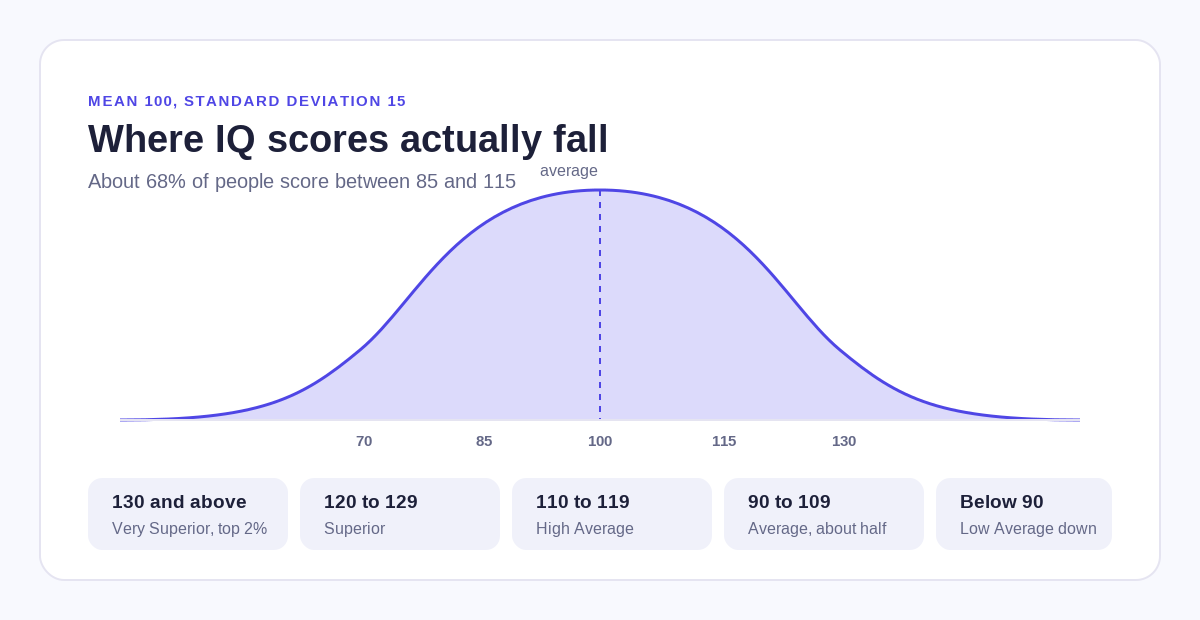
A score of 130 means you scored 30 points, or exactly 2 standard deviations, above the average for people your age. IQ scores are ranks, not counts of right answers. Modern tests set the average at 100 and the step size at 15, so 130 always marks the same spot on the curve.
The round number is not an accident. Two standard deviations is a common cut-off in statistics and in clinical work. Test makers built their labels around it, and schools borrowed it for gifted programs. That is why this score carries more weight than 128 or 133, even though the gap in ability is tiny.
It also helps to know what the score is compared against. Your result is set against a large sample of people your own age, called the norm group. A 9-year-old and a 45-year-old who both score 130 have each done far better than their own peers. They have not done the same raw work.
The history of intelligence testing shows that this ranking approach was built in from the start. A score was never meant to stand alone, without the curve behind it.

What percentile is an IQ of 130?
A score of 130 is at the 97.7th percentile. On a scale with a mean of 100 and a standard deviation of 15, about 97.7% of people score below it and about 2.3% score at or above it. That is roughly 1 person in 44. Many sources round this up to the 98th percentile.
In a city of one million adults, that still means about 22,700 people. A score of 130 is uncommon, but it is not exotic. Most people have met many such people at school or at work without ever knowing it.
The table shows how fast the share of people shrinks as scores rise. Every figure comes from the normal distribution with a mean of 100 and a standard deviation of 15.
| IQ score | Percentile | Share at or above | Roughly how common |
|---|---|---|---|
| 100 | 50th | 50% | 1 in 2 |
| 115 | 84th | 16% | 1 in 6 |
| 120 | 91st | 9.1% | 1 in 11 |
| 125 | 95th | 4.8% | 1 in 21 |
| 130 | 97.7th | 2.3% | 1 in 44 |
| 135 | 99.0th | 0.98% | 1 in 102 |
| 140 | 99.6th | 0.38% | 1 in 261 |
| 145 | 99.87th | 0.13% | 1 in 741 |
Look at how quickly the tail thins. Going from 130 to 140 makes a score about six times rarer. You can check any other number with our IQ percentile calculator.
What label do tests give a score of 130?
The label depends on the test and its edition. The adult WAIS-IV calls a score of 130 or more “Very Superior”. The newer children’s WISC-V calls the same band “Extremely High”. The two labels describe the same position, which is the top 2.3% or so of people the same age.
Newer manuals moved away from words like “superior” on purpose. Those words sound like a judgement about a person, while a percentile rank is only a position. In a Pearson sample report for the WISC-V, index scores of 132 and 138 carry the “Extremely High” label, and a full-scale score of 129 is “Very High”.
Older labels were even stronger. In his 1916 manual for the Stanford-Binet, Lewis Terman called scores from 120 to 140 “very superior intelligence” and scores above 140 “near genius or genius”. No modern manual uses the word genius. Whatever the label, 130 is still the 97.7th percentile.
How sharp is your mind?
Take the Iq Quiz Test and get your personalised report instantly.
Start the Test →Is an IQ of 130 gifted?
Under most formal rules, yes. A score of 130 is the most common entry line for school gifted programs, because it sits exactly 2 standard deviations above the mean. But schools differ. Some use lower cut-offs, some compare students only with their own school, and many look at more than an IQ score.
The cut-off is a policy choice, not a fact about the brain. Nothing changes at 129. A child who scores 128 and one who scores 131 are, in practice, at the same level. The line exists because programs need a rule, and 2 standard deviations gives a group of manageable size.
How children are found also matters. Economists David Card and Laura Giuliano studied one large Florida school district. When it screened every student instead of waiting for parent and teacher referrals, many more poor and minority children met the IQ standard for gifted status.
Our guide to the gifted IQ score covers where the 130 line came from and how schools identify gifted children today.
Can an IQ of 130 get you into Mensa?
Yes, if the score came from an approved, supervised test. Mensa admits people who score at or above the 98th percentile. American Mensa accepts a full-scale IQ of 130 on the Wechsler tests, 130 on the Stanford-Binet 5, 132 on older Stanford-Binet editions and 148 on the Cattell.
Those different numbers show why the scale matters. The rule is always a percentile. Each test simply writes that percentile as a different number, because each test uses its own spread. The often repeated claim that Mensa “needs 132” is true for one older test and wrong for the rest.
Mensa does not accept free online tests. Mensa International says online tests cannot be used for admission. You either sit a supervised Mensa admission test or send in a qualifying score from an approved test given by a qualified professional.
Our Mensa IQ test guide lists the accepted tests and how to apply with prior evidence.
Why does the scale change the meaning?
Not every IQ test uses a standard deviation of 15. Older Stanford-Binet editions used 16, and the Cattell scale uses 24. On a scale with a standard deviation of 24, a score of 130 is only 1.25 deviations above the mean. That is about the 89th percentile, or roughly 1 person in 9.
So the same three digits can mean the top 2.3% or the top 11%, depending only on which test produced them. This is the biggest source of confusion in online IQ talk. It is also why two friends can both say “I got 130” and mean very different things.
Before you compare any two scores, look for these details on the report:
- The name and edition of the test that was used.
- The standard deviation of the scale, usually 15, 16 or 24.
- The percentile rank, which is the one figure that moves cleanly between tests.
- The confidence interval, if the report gives one.
- The year the norms were set, since old norms tend to give higher scores.
If a score arrives without that context, treat it as a rough guide. Our IQ scale converter turns a score on one scale into its match on another.
How does 130 compare with 100, 120 and 140?
A score of 130 is 30 points above the average of 100, 10 points above 120 and 10 points below 140. In rarity terms, half of people reach 100, about 9.1% reach 120, about 2.3% reach 130 and only about 0.38% reach 140. Equal steps in points are not equal steps in rarity.
IQ of 130 versus 100
An IQ of 100 is the exact middle, the 50th percentile. The gap to 130 is two full standard deviations. It is the same distance, in the other direction, as the gap from 100 down to 70. Our guide to an IQ of 100 explains the average in detail.
IQ of 130 versus 120
Ten points sounds small, but the share of people above you falls from about 9.1% to about 2.3%. That is a drop of about three quarters. Our IQ of 120 guide covers the band just below this one.
IQ of 130 versus 140
Another 10 points cuts the share again, from about 1 in 44 to about 1 in 261. A score of 140 is where Terman’s old “genius” label began. Our guide to an IQ of 140 looks at what that rarer score does and does not mean.
What does an IQ of 130 predict?
A score of 130 predicts better than average results at school and, to a smaller degree, at work. The links are real but moderate. Large reviews put the link with school grades near 0.5 and the link with job performance near 0.3, which leaves most of the difference between people unexplained.
School is where IQ predicts best. A 2015 meta-analysis by Roth and colleagues, covering 240 samples and more than 100,000 students, found a corrected correlation of 0.54 between intelligence and school grades.
Work is more debated. An influential 1998 review by Schmidt and Hunter put the link between cognitive ability and job performance at about 0.5. A 2022 re-analysis by Sackett and colleagues argued that earlier corrections were too large and revised it to 0.31. In that re-analysis, structured interviews scored higher, at 0.42.
A common claim says extra IQ points stop mattering past a threshold. The best long-term data do not support that. The Study of Mathematically Precocious Youth followed children in the top 1% of reasoning ability. Even inside that group, differences in ability still predicted educational, career and creative achievements decades later.
What the number does not tell you:
- How conscientious and organised you are.
- Whether you finish hard work without outside pressure.
- How you deal with failure and setbacks.
- Which subjects and problems truly interest you.
- How much knowledge you have built in your field.
The score describes a capacity. It says nothing about what you choose to do with it.
Does a high score lead to a better life?
On average, high scorers do somewhat better on education and income, but the spread is wide. The best-known evidence comes from Lewis Terman’s study of gifted California children, begun in the 1920s. Many did well, yet the group was not protected from ordinary problems, and none won a Nobel Prize.
Terman’s core group of 643 children had IQs of 135 or higher, and the study grew to 1,528 people. According to a Stanford Magazine history of the project, two thirds earned bachelor’s degrees, far above the national rate at the time. The group produced 97 PhDs, 57 medical doctors and 92 lawyers.
The same history notes that the group divorced, became alcoholics and died by suicide at about the national rate. They were no more and no less stable than other people. Two boys who were tested but did not make the cut, William Shockley and Luis Alvarez, later won the Nobel Prize in Physics.
The lesson is balanced. A score of 130 raises the odds of some good outcomes across a group. It does not decide any one person’s life. We look at the harder side of high ability in high IQ problems.

How big is the margin of error near 130?
Every IQ score has a margin of error, even from a supervised test. In a Pearson sample WISC-V report, a full-scale score of 129 comes with a 95% confidence interval of 122 to 133. So a reported IQ of 130 is best read as a range that runs from the low 120s to the mid 130s.
That range matters more at 130 than almost anywhere else, because a formal cut-off sits inside it. A child who tests at 128 and one who tests at 132 are not reliably different. Yet one may get a gifted place and the other may not. Good programs use more than one source of evidence for this reason.
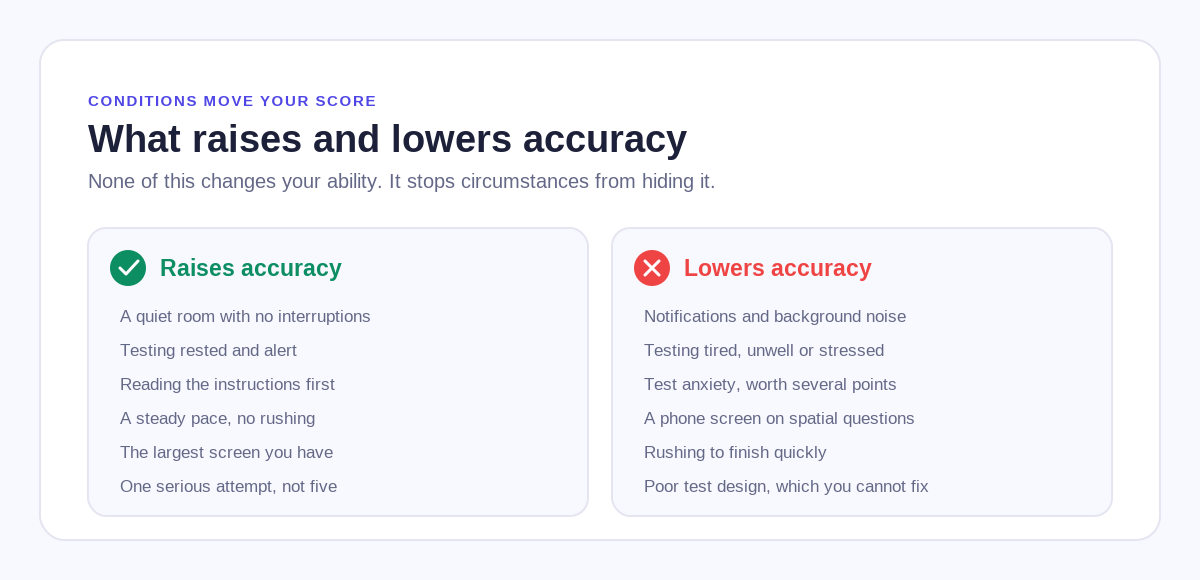
Scores also move from one sitting to the next. Sleep, illness, stress and practice all play a part. A large meta-analysis by Scharfen and colleagues found that simply retaking a cognitive test raised scores by about a third of a standard deviation on average. On an IQ scale, that is about 5 points.
Anyone who quotes their IQ to the exact digit is claiming more precision than any test can give.
Is an online score of 130 the same as a supervised one?
No. A 130 from a free online test and a 130 from a supervised test are different claims. Supervised tests are given one to one by a trained examiner and normed on large, representative samples. Online tests are shorter, taken alone, and often normed on whoever chose to take them.
The main adult test is the Wechsler Adult Intelligence Scale. Pearson lists 60 to 90 minutes for the WAIS-IV core subtests, given face to face. An online test cannot check for distraction, outside help or repeat attempts, and all three tend to push scores up.
That does not make online tests useless. A well-built one can give a sensible first estimate, especially if you have never been tested. Just read the result as a wider range than a supervised score. Our guide on whether online IQ tests are accurate explains what separates a useful test from a quiz.
If you plan to use a score for anything formal, such as a school place or a Mensa application, you will need a supervised result. For curiosity and self-knowledge, a careful online test is a fair place to start.
How sharp is your mind?
Take the Iq Quiz Test and get your personalised report instantly.
Start the Test →What should you do with your IQ of 130?
Treat the score as useful information, not a verdict. Look at the percentile, the confidence range and the pattern across different skills. Then use what you learn to make practical choices about study, work and the kinds of problems you most enjoy solving.
- Read it as a band. Think “around the 97th or 98th percentile, give or take a few points”, not “exactly 130”.
- Check the scale. Make sure the test used a standard deviation of 15 before you compare it with anyone else’s score.
- Look at the profile. Verbal, visual, memory and speed scores often differ, and the pattern says more than the total.
- Get a better estimate if it matters. Take the Mindaura IQ test for a fresh baseline, or book a supervised test for formal needs.
- Keep building skills. Education adds to measured ability. A meta-analysis by Ritchie and Tucker-Drob found about 1 to 5 IQ points for each extra year of schooling.
If you want a deeper written breakdown of your result, you can see what the full Mindaura report includes on our pricing page. Our guide on whether you can improve your IQ covers what training can and cannot change.
Frequently asked questions
Is an IQ of 130 good?
What percentile is an IQ of 130?
Is an IQ of 130 considered gifted?
Can you join Mensa with an IQ of 130?
Does an IQ of 130 mean the same thing on every test?
Is an IQ of 130 genius level?
How accurate is an IQ of 130 from an online test?
What is the margin of error on an IQ of 130?
Sources
- Mensa International. Getting your IQ tested: FAQs.
- American Mensa. Qualifying test scores.
- Pearson. WISC-V UK sample score report.
- Pearson. Wechsler Adult Intelligence Scale, Fourth Edition.
- Terman, L. M. (1916). The Measurement of Intelligence. Houghton Mifflin, page 79.
- Leslie, M. (2000). The vexing legacy of Lewis Terman. Stanford Magazine.
- Roth, B., and colleagues (2015). Intelligence and school grades: a meta-analysis. Intelligence, 53, 118 to 137.
- Society for Industrial and Organizational Psychology. Is cognitive ability the best predictor of job performance? (summary of Sackett and colleagues, 2022).
- Robertson, K. F., Smeets, S., Lubinski, D., and Benbow, C. P. (2010). Beyond the threshold hypothesis. Current Directions in Psychological Science, 19(6), 346 to 351.
- Card, D., and Giuliano, L. (2016). Universal screening increases the representation of low-income and minority students in gifted education. PNAS.
- Scharfen, J., Peters, J. M., and Holling, H. (2018). Retest effects in cognitive ability tests: a meta-analysis. Intelligence, 67, 44 to 66.
- Ritchie, S. J., and Tucker-Drob, E. M. (2018). How much does education improve intelligence? A meta-analysis. Psychological Science, 29(8), 1358 to 1369.