
An IQ of 120 sits at about the 91st percentile on a test with a mean of 100 and a standard deviation of 15. That means roughly 9 people in 100, or about 1 in 11, score at or above it. Wechsler tests label the 120 to 129 band “Very High”, formerly “Superior”.
Here is a worked example. Picture an office of 100 randomly chosen adults who all sit the same supervised IQ test. If you score 120, about 90 of them score below you and about 9 score at or above you. You would stand out, but you would not be alone. To see how every other score compares, start with our IQ score chart.
Key facts, with sources
- An IQ of 120 is 1.33 standard deviations above the mean of 100 on Wechsler-style scales (normal distribution).
- That puts it at about the 91st percentile, or roughly 1 person in 11.
- Pearson’s WISC-V labels 120 to 129 “Very High” and 130 or more “Extremely High”.
- Mensa needs the 98th percentile, which is 130 on the Wechsler scales, so 120 does not qualify (Mensa).
- In a Pearson sample report, a full-scale IQ of 129 carries a 95% confidence interval of 122 to 133.
In this guide
- What does an IQ of 120 mean?
- What percentile is an IQ of 120?
- What label do tests give a score of 120?
- Why does the scale matter more than the number?
- How does 120 compare with 100, 130 and Mensa?
- What does an IQ of 120 predict?
- Is a score of 120 gifted?
- How big is the margin of error?
- Are online scores the same as supervised scores?
- What should you do with your score?
- Frequently asked questions
- Sources
What does an IQ of 120 mean?
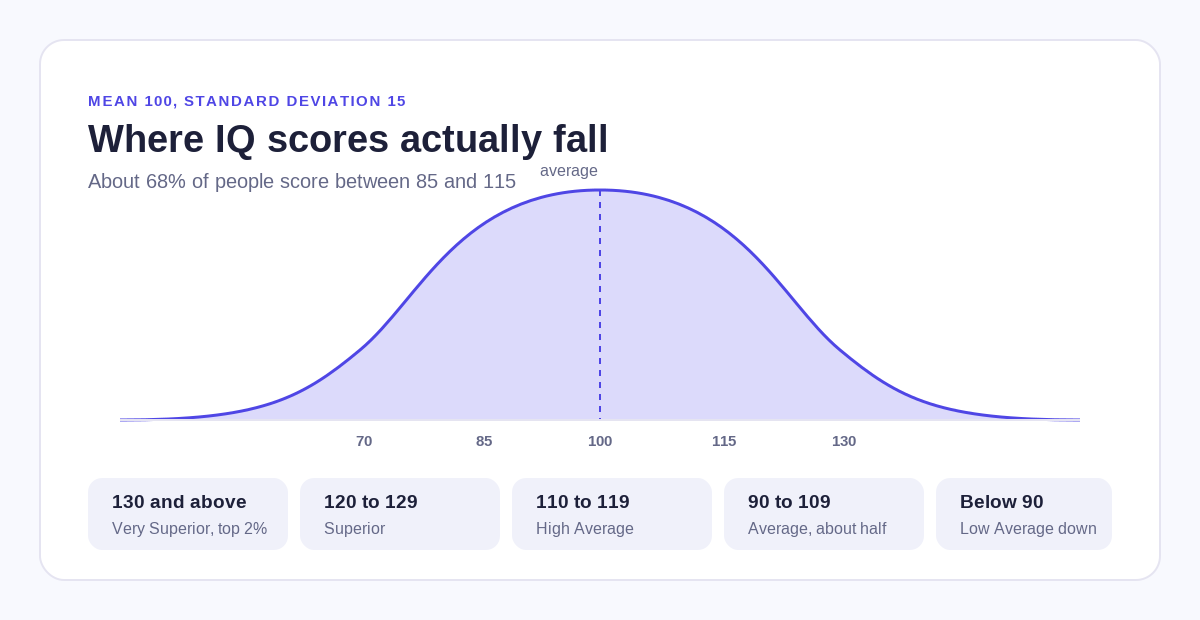
A score of 120 means you scored 20 points, or 1.33 standard deviations, above the average for your age group. IQ scores are rankings, not counts of correct answers. Modern tests are built so the average is exactly 100 and the standard deviation is 15, so 120 marks a fixed position on the curve.
The number itself is a convention. Test publishers chose 100 as the middle and 15 as the step size. What is not arbitrary is the position the number describes: how your result compares with a large, representative group of people your age.
This is why the same raw performance can give different numbers on different tests. It also explains why your IQ is always relative to your own age group, not to some fixed standard of brain power. A 10-year-old and a 40-year-old who both score 120 have each scored well above their own peers.
The history of intelligence testing shows how deliberate that design choice was. Scores were never meant to be read without the curve behind them.

What percentile is an IQ of 120?
A score of 120 is at about the 91st percentile. On a scale with a mean of 100 and a standard deviation of 15, about 90.9% of people score below 120 and about 9.1% score at or above it. That works out to roughly 1 person in 11.
In a workplace of 100 people, about nine colleagues would score at or above your level. In a city of one million adults, about 91,000 people would. A score of 120 is clearly above average and uncommon, but it is not rare. Most people meet many such people without noticing.
The table shows how quickly the numbers thin out as scores rise. All figures come from the normal distribution with a mean of 100 and a standard deviation of 15.
| IQ score | Percentile | Share at or above | Roughly how common |
|---|---|---|---|
| 100 | 50th | 50% | 1 in 2 |
| 110 | 75th | 25% | 1 in 4 |
| 115 | 84th | 16% | 1 in 6 |
| 120 | 91st | 9.1% | 1 in 11 |
| 125 | 95th | 4.8% | 1 in 21 |
| 130 | 97.7th | 2.3% | 1 in 44 |
| 140 | 99.6th | 0.38% | 1 in 261 |
Notice how the gaps widen. Moving from 110 to 120 cuts the share of people above you from about a quarter to about a tenth. Moving from 130 to 140 cuts it by a factor of about six. You can check any score yourself with our IQ percentile calculator.
What label do tests give a score of 120?
Most current Wechsler tests call a score of 120 to 129 “Very High”. Older editions, including the WAIS-IV and WISC-IV, called the same band “Superior”. The change was deliberate. Words like superior carry a judgement that a percentile rank does not, so newer manuals use more neutral wording.
You can see the newer labels in a Pearson sample report for the WISC-V. A full-scale IQ of 129 is labelled “Very High”, while index scores of 132 and 138 are labelled “Extremely High”. The line between the two labels sits at 130.
The Stanford-Binet 5 uses the same mean and standard deviation, with its own wording for each band. Whatever the manual calls it, a 120 is still the 91st percentile. The label changes. The position does not.
How sharp is your mind?
Take the Iq Quiz Test and get your personalised report instantly.
Start the Test →Why does the scale matter more than the number?
The scale matters because not every IQ test uses a standard deviation of 15. Older Stanford-Binet editions used 16, and the Cattell scale uses 24. On a scale with a standard deviation of 24, a score of 120 is only 0.83 deviations above the mean, which is about the 80th percentile.
So the same number can mean the 91st percentile on one test and the 80th on another. This is one of the biggest sources of confusion in online IQ talk. It is also why Mensa lists different qualifying numbers for different tests, even though the rule behind them is always the 98th percentile.
Before you compare any two scores, check these details on the report:
- Which test was used, by name and edition.
- The standard deviation of the scale, usually 15, 16 or 24.
- The percentile rank, which is the only figure that transfers cleanly between tests.
- The confidence interval, if the report gives one.
- The norm group your score was compared against.
If a score comes without that information, treat the number as a rough estimate. Our IQ scale converter turns a score from one scale into another.
How does 120 compare with 100, 130 and Mensa?
A score of 120 is 20 points above the average of 100 and 10 points below the usual gifted line of 130. In rarity terms, about half of people reach 100, about 9% reach 120 and only about 2.3% reach 130. Mensa’s cut-off, the 98th percentile, lines up with 130 on Wechsler tests.
IQ of 120 versus 100
An IQ of 100 is the exact middle, the 50th percentile. The gap to 120 is a little over one and a third standard deviations. In daily life that gap tends to show up in how quickly people pick up new, complex material. It rarely shows up in ordinary conversation. Our guide to an IQ of 100 covers the average in detail.
IQ of 120 versus 130
Ten points sounds small, but the share of people above you drops from about 9.1% to about 2.3%. That is a drop of about three quarters. A score of 130 is the usual line for gifted programs, which our IQ of 130 guide covers in full.
IQ of 120 versus Mensa
Mensa admits people who score at or above the 98th percentile on an approved, supervised test. On the Wechsler scales that is 130. A score of 120 falls short by a clear margin. Our Mensa qualifying score guide lists the accepted tests and cut-offs.
What does an IQ of 120 predict?
A score of 120 predicts better-than-average results in school and, to a smaller degree, at work. But the links are moderate, not strong. Large reviews put the link with school grades near 0.5 and the link with job performance nearer 0.3, which leaves most of the difference between people unexplained.
School is where IQ predicts best. A meta-analysis by Roth and colleagues, covering 240 samples and more than 100,000 students, found a corrected correlation of 0.54 between intelligence and school grades.
Work is more debated. An influential 1998 review by Schmidt and Hunter put the link between cognitive ability and job performance at 0.51. A 2022 re-analysis by Sackett and colleagues argued that earlier corrections were too large, and revised the figure to 0.31. That still matters. It is just not the whole story.
What the number does not tell you:
- How conscientious you are, which also predicts how well people do at work.
- Whether you finish what you start.
- How you handle stress, conflict or boredom.
- What you are actually interested in.
- How much knowledge you have built in your field.
People who score around 120 are common in demanding professional fields. They are also found in every other walk of life. The score describes a capacity. It says nothing about what you do with it.

Is an IQ of 120 gifted?
Under most formal definitions, a score of 120 is not gifted. The usual gifted line is 130, about the 97.7th percentile. But some schools use lower or flexible cut-offs, and many look at more than an IQ score. So a 120 can qualify for a program in some places and not in others.
Rules vary a lot. Florida, for example, sets 130 as the minimum but allows districts to use a lower bar for some groups. One large district used 116 for low-income students and English learners. The National Association for Gifted Children does not set any IQ cut-off at all.
The fair way to describe 120 is “well above average, below the usual gifted range”. Our guide to the gifted IQ score explains where the 130 line came from and how schools actually identify gifted children.
How big is the margin of error?
Even a supervised IQ score has a margin of error of several points. In a Pearson sample WISC-V report, a full-scale IQ of 129 has a 95% confidence interval of 122 to 133. So a reported 120 is best read as a range that runs from the mid-110s to the mid-120s.
That range matters. It means a 118 and a 122 are not really different results. Both are the same performance plus normal noise. Notice also that the interval is not always the same size on both sides, because publishers build it around an estimated true score.
Scores also move between sittings. Sleep, illness, stress and practice can shift a result by a few points. A large meta-analysis by Scharfen and colleagues found that simply retaking a cognitive test raised scores by about a third of a standard deviation, or about 5 IQ points, on average.
Anyone who quotes their IQ to the exact digit is claiming more precision than the test can give. Our guide on whether IQ changes with age covers how scores shift over a lifetime.
Are online scores the same as supervised scores?
No. A 120 from a free online test and the same number from a supervised test are different claims. Supervised tests are given one to one by a trained examiner and normed on large, representative samples. Online tests are shorter, taken alone, and often normed on whoever chose to take them.
The gold-standard adult test is the Wechsler Adult Intelligence Scale, now in its fifth edition. Pearson says the earlier WAIS-IV core battery took about 60 to 90 minutes. Online tests cannot control for distraction, outside help or repeat attempts.
That does not make online tests useless. A well-built one can give a reasonable first estimate, especially if you have never been tested. Just read the result as a wider range than a supervised score. Our guide on whether online IQ tests are accurate explains what separates a useful test from a quiz.
How sharp is your mind?
Take the Iq Quiz Test and get your personalised report instantly.
Start the Test →What should you do with your score?
Treat your score as a useful starting point, not a verdict. Look at the percentile, the confidence range and the pattern across different skills. Then use what you learn to make practical choices about study, work and the kinds of problems you enjoy most.
- Read it as a band. Think “about the 91st percentile, give or take a few points”, not “exactly 120”.
- Look at the profile. Verbal, visual, memory and speed scores often differ, and the pattern says more than the total.
- Check the scale. Make sure your score uses a standard deviation of 15 before you compare it with others.
- Get a better estimate if it matters. Take the Mindaura IQ test for a fresh baseline, or book a supervised test for formal needs.
- Build skills on top. Education keeps adding to measured ability. A meta-analysis found about 1 to 5 IQ points per extra year of schooling.
If you want a deeper written breakdown of your result, you can see what the full Mindaura report includes on our pricing page.
Frequently asked questions
Is an IQ of 120 good?
What percentile is an IQ of 120?
Is an IQ of 120 considered gifted?
Can you get into Mensa with an IQ of 120?
Does an IQ of 120 mean the same thing on every test?
How accurate is an IQ of 120 from an online test?
Can an IQ of 120 go up?
What is the margin of error on an IQ of 120?
Sources
- Pearson. WISC-V UK sample score report.
- Pearson. Wechsler Adult Intelligence Scale, Fourth Edition.
- Mensa International. Getting your IQ tested: FAQs.
- American Mensa. Qualifying test scores.
- Roth, B., and colleagues (2015). Intelligence and school grades: a meta-analysis. Intelligence, 53, 118 to 137.
- Society for Industrial and Organizational Psychology. Is cognitive ability the best predictor of job performance? (summary of Sackett and colleagues, 2022).
- Scharfen, J., Peters, J. M., and Holling, H. (2018). Retest effects in cognitive ability tests: a meta-analysis. Intelligence, 67, 44 to 66.
- Ritchie, S. J., and Tucker-Drob, E. M. (2018). How much does education improve intelligence? A meta-analysis. Psychological Science, 29(8), 1358 to 1369.
- Card, D., and Giuliano, L. (2016). Universal screening increases the representation of low-income and minority students in gifted education. PNAS.